
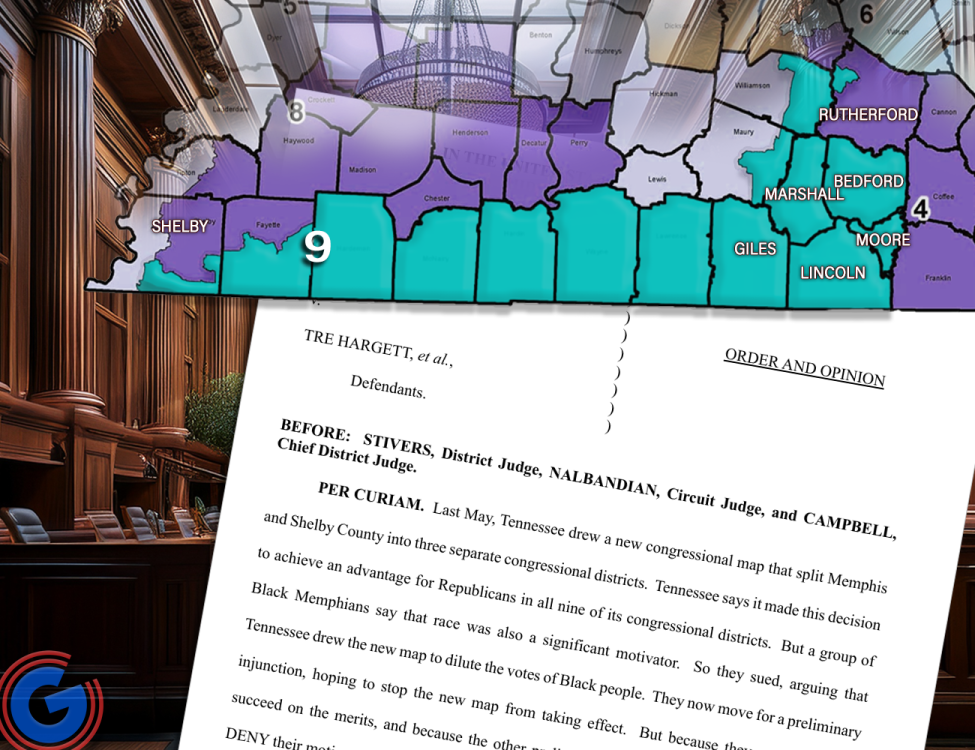
NASHVILLE, Tenn. (WGNS News) - A federal court has denied a request to temporarily block Tennessee’s newly redrawn congressional map, a decision that carries implications beyond Memphis because the revised 9th Congressional District now extends into a portion of Rutherford County.
Under the previous congressional map, Tennessee’s 9th District was centered in Memphis and did not include any part of Rutherford County. The newly enacted boundaries substantially reshape the district, connecting voters from portions of Shelby County with communities extending eastward across the state, including part of Rutherford County.
The Tennessee General Assembly approved the revised congressional boundaries in May. The legislation passed the House 64-25 and the Senate 25-5 before being signed by the governor.
The federal lawsuit, Sherman v. Hargett, challenges the restructuring of the former Memphis-area district. It was brought by three Memphis voters, the Black Clergy Collaborative of Memphis, the Memphis A. Philip Randolph Institute and The Equity Alliance. The plaintiffs are represented by the American Civil Liberties Union and the ACLU of Tennessee.
The lawsuit alleges that state lawmakers unlawfully weakened the political influence of Black voters by dismantling a longstanding, geographically compact majority-Black district and distributing Memphis-area voters among multiple congressional districts.
Although the court declined to grant a preliminary injunction, the underlying lawsuit remains pending. The ruling allows the new boundaries—including the portion of Rutherford County placed in District 9—to remain in effect during the upcoming August primary and November general election.
"The decisions by this court continue to further the disenfranchisement of Black voters in Memphis,” said Amber Sherman, named plaintiff and an affected Memphis voter. “It’s painful to know we'll head into another election under a map that was designed to weaken the voices of Black voters in Memphis. We deserve the same opportunity to shape our future as anyone else. When our voting power is diluted, our neighborhoods have a harder time making their voices heard on the issues that shape our daily lives. We may not have won today's ruling, but we aren't giving up. Every voter deserves equal representation, and that's what we'll keep fighting for."
For Rutherford County voters included in the newly configured district, the change represents a significant shift in congressional representation. Instead of being grouped entirely within districts centered in Middle Tennessee, a portion of the county is now connected to a district that includes areas of Memphis and West Tennessee.
“Black voters in Memphis are being forced to use a congressional map that unlawfully dilutes their political power as another critical election approaches," said Ari Savitzky, senior staff attorney with the ACLU's Voting Rights Project. "At a moment when voting rights are under attack across the country and federal officials continue testing the limits of executive power over our elections, courts should be especially vigilant in protecting communities from ongoing discrimination. We are most saddened for our clients and the Black community in Memphis, whose hard-won political power, built on generations of organizing and struggle, was ripped away by the General Assembly at the first possible opportunity. This racially motivated redistricting is wrong and harkens back to a darker time in America’s past. We will continue to fight for the rights of voters in Tennessee and elsewhere even as anti-voter state legislatures declare open season on Black voters’ fundamental right to vote.”
The plaintiffs contend that lawmakers intentionally divided Black neighborhoods and communities in Shelby County, dispersing those voters across multiple districts and reducing their opportunity to elect candidates responsive to their concerns.
“[Thursday's] Today’s ruling means Black voters in Memphis will face the first election since their congressional district was split apart under a map designed to suppress their voting power,” said Lucas Cameron-Vaughn, legal director of the ACLU of Tennessee. “Tennessee lawmakers deliberately divided Black neighborhoods across multiple districts, minimizing their voting strength and their ability to elect leaders who will represent their interests. The court’s order allows this new map to govern both the August primary and November general election. We will continue fighting for a congressional map that offers a meaningful voice in the political process for every Tennessean.”
While the court’s ruling leaves the new map in place for now, it does not end the legal challenge. The plaintiffs plan to continue pursuing permanent relief that could ultimately require Tennessee to redraw its congressional boundaries again.