
UPDATE: Washington, DC – On Friday night (8/2/2025), the U.S. Senate passed two major appropriation bills that carry significant implications for Tennessee: the Fiscal Year 2026 Military Construction, Veterans Affairs, and Related Agencies Appropriations Act, and the Agriculture, Rural Development, Food and Drug Administration, and Related Agencies Appropriations Act. These bills, now awaiting action in the House of Representatives, include key funding for military and agricultural initiatives across the Volunteer State.
Move National Guard to Smyrna – Among the provisions is the funding needed to relocate the Tennessee National Guard from Berry Field in Nashville to the Smyrna-Rutherford County Airport. Senator Marsha Blackburn confirmed the Senate’s support for the transition, a move deemed critical by both state and local officials. She noted that the Guard’s lease at Berry Field expires in 2045 and will not be renewed—making a new base not just timely, but necessary to avoid relocating vital personnel and equipment to other states.
DRONES: Also relocating is the Tennessee Air National Guard’s 118th Wing, currently based at the old Berry Hill site in Nashville. The 118th has multiple responsibilities but is best known for its drone operations.
In 2023, the 118th Wing made history when Nashville-based pilots successfully conducted their first MQ-9 remotely piloted aircraft flight. The large drone flew more than 2,000 miles, taking off from California and landing in Smyrna, Tennessee. According to officials, the flight was especially notable because it was completed without the ground crew or support infrastructure typically required for line-of-sight taxiing, takeoff, and landing. Scroll down for video.
Now, two years later, MQ-9 Reapers are remotely operated on a regular basis, with pilots and sensor operators in Nashville controlling drones based in California. These remote pilots are expected to be among the first personnel to relocate to Smyrna. The Reapers’ mission is to provide persistent intelligence, surveillance, reconnaissance, and combat capabilities to the U.S. Air Force.
SMYRNA and the MILITARY: Smyrna, the site of the former Sewart Air Force Base, is well-equipped to handle the Guard’s missions. It supports aircraft of all sizes and, 24/7, hosts large commercial jets landing there for maintenance. According to Blackburn, expanding the training site at Smyrna will ensure state and federal response capabilities remain strong, especially given its proximity—just 12 miles from Berry Field.
The move is also practical for the workforce. Of the roughly 1,700 Guardsmen currently assigned to Berry Field, 73 percent reside within 50 miles of Smyrna. Relocation not only benefits these service members, but also preserves an estimated $145 million in annual economic impact for Middle Tennessee.
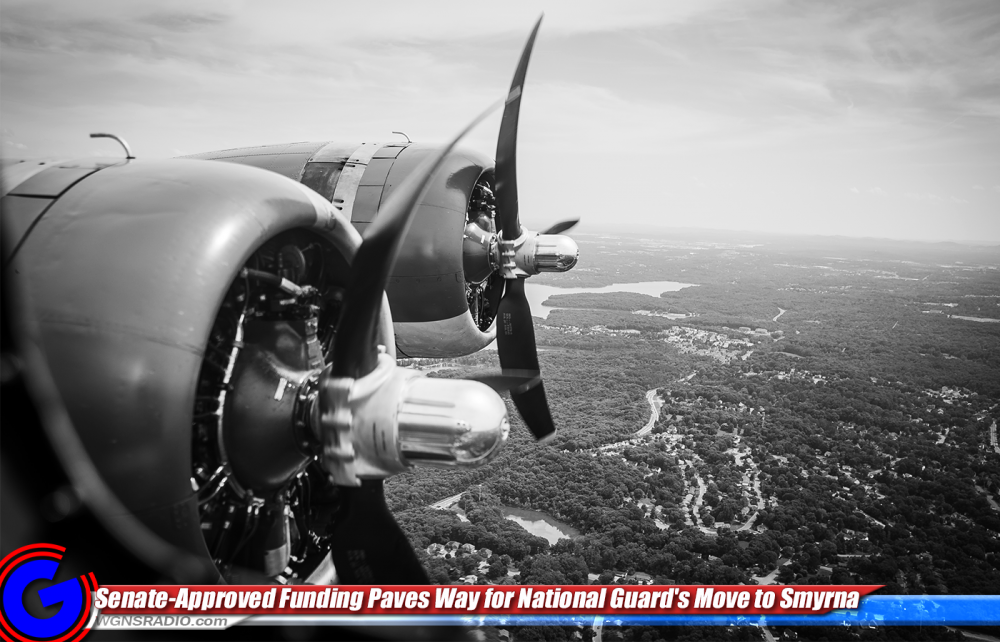
Senator Blackburn emphasized the dual importance of the legislation: strengthening military readiness while advancing agricultural research. “Tennessee is home to both critical military bases and installations and a thriving agriculture industry,” she said. “These bills deliver key investments to modernize Fort Campbell, bolster the Tennessee National Guard, and support groundbreaking innovation at our world-class universities.” Scroll down to learn more about the photo above this article.
PHOTO ABOVE ARTICLE: The view from inside a restored B-17 flying over Middle Tennessee in 2019... During WWII, the Sewart Air Force Base in Smyrna, TN—which is the area that those at Berry Field in Nashville will be moving to—was known for its B-17 Flying Fortress pilot training. It also served as a training base for pilots learning to fly the B-24 Liberator. Military history runs deep throughout Middle Tennessee and will continue for years to come.