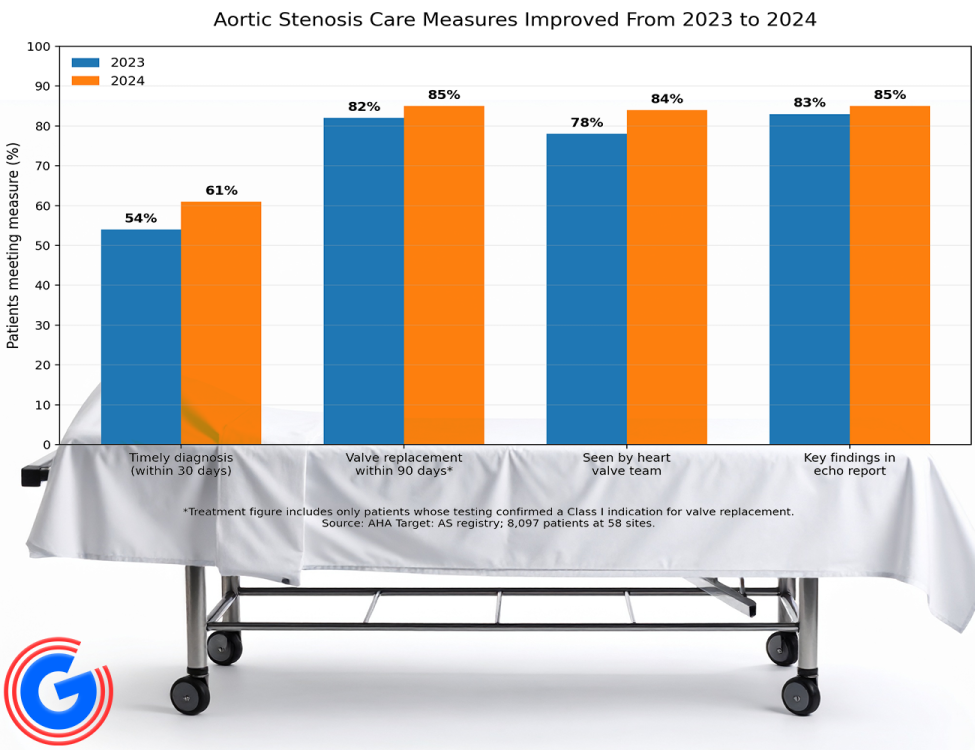

HEALTH NEWS: A new national health registry is working to improve care for people with aortic stenosis, a common and serious condition in which the heart’s aortic valve becomes too narrow to open properly. Researchers with Vanderbilt Health and the American Heart Association found that many patients are not being diagnosed or treated as quickly as recommended, increasing their risk of serious illness or death. The standard treatment for severe aortic stenosis is an aortic valve replacement, which should generally be performed within 90 days after doctors confirm that it is needed because medication cannot correct the narrowed valve. Researchers reviewed more than 8,000 patients at 58 medical centers and found that only 54% received a timely diagnosis in 2023, improving to 61% in 2024. Among patients whose need for valve replacement was fully confirmed, 82% received treatment within 90 days in 2023 and 85% did so in 2024. The study also found that many patients missed follow-up heart scans and that echocardiogram reports rarely included clear recommendations for the next step in care. Dr. Brian Lindman of Vanderbilt said the findings show major gaps in the diagnosis, monitoring and treatment of aortic stenosis, but improvements between 2023 and 2024 suggest that tracking care and sharing successful practices can help hospitals provide faster and more effective treatment.
FULL DETAILS: Undertreatment and delayed treatment of aortic stenosis lead to increased mortality, but a new multicenter registry led, in part, by a Vanderbilt Health researcher along with the American Heart Association (AHA) is aiming to improve outcomes for patients nationwide.
Aortic stenosis (AS) is the most common type of heart valve disease in developed nations, affecting over 2.5 million people in the United States alone, about 5% to 10% of older adults. It occurs when the aortic valve narrows and fails to open fully and is caused by calcification and fibrosis of the valve leaflets.
The AHA Target: AS registry is the first national registry to track data and evaluate the quality of upstream care processes before valve replacement for patients with AS. Brian Lindman, MD, MSCI, Associate Professor of Medicine, is the first author of the first major report on the registry, which was recently published in the AHA journal Circulation.
In the paper, Lindman, who is Medical Director of the Structural Heart and Valve Center at Vanderbilt Heart and Vascular Institute, and other authors identified numerous gaps in care for patients with AS.
The standard of care for patients with severe AS is to undergo an aortic valve replacement (AVR) within 90 days of diagnosis. Medication is not an option for these patients, Lindman said, and they are at a significant risk of death if they do not have a timely diagnosis and quick aortic valve replacement.
“Despite having a recommendation to have valve replacement, many studies have shown that upward of 50% of patients who have severe symptomatic aortic stenosis are not getting treated with aortic valve replacement in a timely manner,” Lindman said. “This has a huge impact on survival, and this is a big problem.”

Prior to the Target: AS registry about six years ago, existing registries focused on peri- and postprocedural outcomes but not upstream processes of care. The paper describes how researchers studied 8,097 randomly sampled patients with moderate or severe AS at 58 sites and evaluated performance on quality measures in 2023 and 2024.
Researchers collected data on two main criteria — timely diagnosis (the percentage of patients who had all required diagnostic testing and clinical evaluations to help determine whether a Class I indication for AVR existed within 30 days of an echocardiogram that demonstrated definite or potentially severe AS) and timely treatment (the percentage of patients treated with AVR within 90 days of being deemed to have a Class I indication for AVR).
Researchers found that as few as 54% of patients in the registry in 2023 (61% in 2024) received a timely diagnosis, with gaps caused by lack of timely symptom assessment; lack of stroke volume index; or lack of timely multimodality testing. “This points to large numbers of patients with potentially severe AS not being correctly identified, which may contribute to delayed treatment or undertreatment” with AVR, the paper states.
For the timely treatment measure, 82% of patients in 2023 and 85% in 2024 received an AVR within 90 days after receiving a Class I indication. But Lindman cautioned that this was only for patients who had all the assessments performed to confirm that they had a Class I indication for AVR; as such, timely diagnosis and treatment measures must be considered together.
Researchers also considered secondary measures, including whether those undergoing AVR were seen by the multidisciplinary heart valve team, which comprises cardiac surgeons, interventional cardiologists, imaging experts and others. They found that occurred for 78% of patients in 2023 and 84% in 2024.
They considered the completeness of the echocardiogram reports and whether patients received timely surveillance echocardiograms. Key findings in the echocardiogram report were documented in 83% of patients in 2023 and 85% of patients in 2024, but a clinical recommendation was included less than 10% of the time. The authors found that timely follow-up surveillance echocardiograms were missing about 40% of the time in patients in the sample, which could result in delayed treatment.

Lindman said the registry continues to grow, with a goal to expand it to 200 sites in the next five years and to expand beyond AS to collect patient data on mitral and tricuspid valve regurgitation.
“The registry was very helpful in identifying substantial gaps in the management, evaluation and treatment of patients with aortic stenosis,” Lindman said. “Notably, we saw improvement when we compared performance across sites in the registry from 2023 to 2024. It is encouraging that although large gaps were seen, participation in the registry and some of the learning and sharing of best practices that occurred there were leading to improvement in performance on these quality measures.”