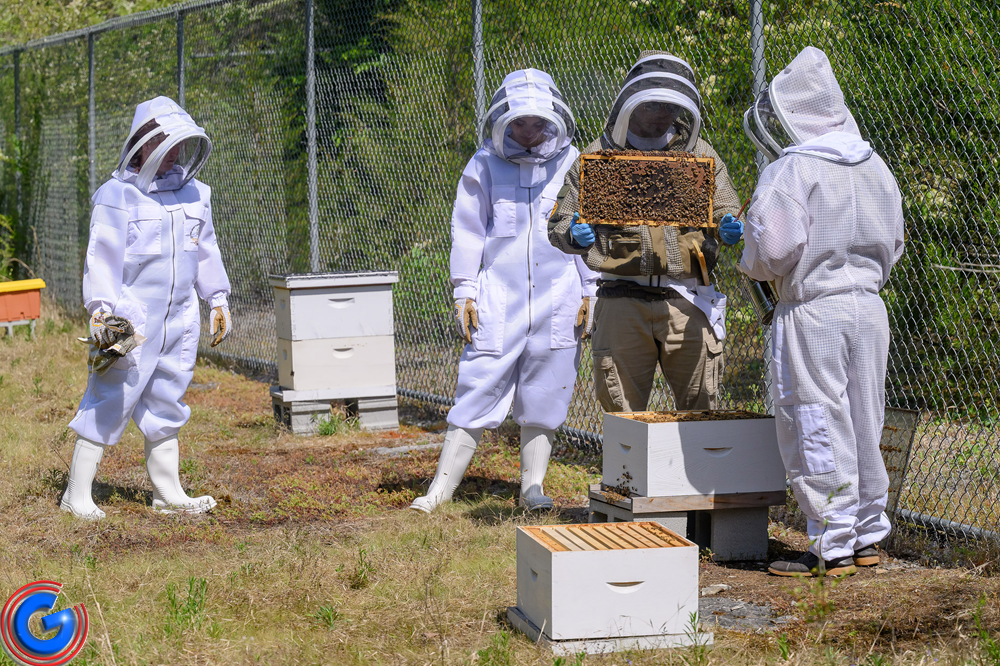
MTSU photo by J. Intintoli

LASCASSAS, TN (WGNS) - Out at the MTSU Small Farm in Lascassas, the soundtrack is unmistakable: a steady, vibrating hum from thousands of honeybees swirling around their hives. Assistant biology professor Manuel Giannoni‑Guzmán stands beside them in his beekeeping jacket, watching the colonies work while his team studies something far more hidden than honey production — the bees’ internal sense of time.
“Our lab is interested in how bee brains process and encode time of day information,” he said, explaining that honeybees, like humans, rely on a biological clock to guide their behavior. Thanks to a newly awarded $200,000 USDA National Institute of Food and Agriculture grant, Giannoni‑Guzmán and his student researchers are digging deeper into how that clock works and how environmental stressors might disrupt it.
The team maintains 10 colonies at the farm and plans to establish an apiary near the MTSU Science Building to expand research and educational opportunities. Honeybees make ideal subjects because their daily routines — from foraging to temperature regulation — depend heavily on precise timing. To understand the “how” behind those behaviors, researchers will engineer viruses that deliver fluorescent markers, allowing them to see when neurons activate and how they respond to changing conditions.
Bees as Environmental Messengers Doctoral student Jocelyn Bransford says the work could reveal how pesticides and climate instability affect bees long before colonies collapse. “The pesticide industry often says, ‘Well, it doesn’t kill bees, so it’s safe,’ which is probably not true,” she said. Honeybees act as environmental biomarkers, offering early warnings when ecosystems begin to falter.
Giannoni‑Guzmán notes that declines in foraging and navigation — both tied to circadian rhythm — often precede colony failure. By spotting disruptions early, beekeepers and farmers could intervene before hives crash.
Hands-On Science with Real Impact For MTSU alumnus Jack Huckabay, the bee lab has been a rare chance to blend fieldwork with neuroscience. “We’ve learned how to study neurons in bee brains and monitor behavior,” he said while inspecting a honeycomb frame.
And the research reaches beyond agriculture. Honeybees share surprising genetic similarities with mammals, making them powerful models for understanding how circadian rhythms influence human health. “Bees are incredibly social, and their clocks respond strongly to social cues — just like ours,” Giannoni‑Guzmán said.

As the team continues mapping the honeybee’s internal clock, they hope their discoveries will help protect pollinators, strengthen agriculture, and shed light on how time shapes life for all of us — from the hive to humanity.