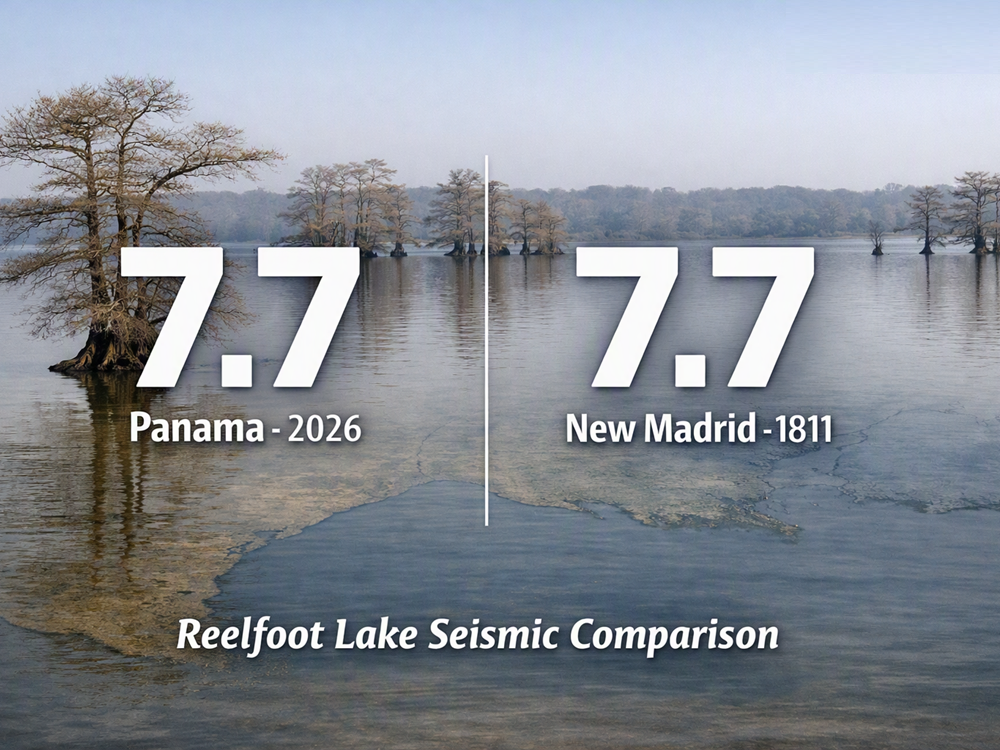
PANAMA (WGNS) - A powerful 7.7‑magnitude earthquake rocked southern Panama this weekend, sending shockwaves through several provinces and triggering more than 200 aftershocks. Homes were damaged, roads cracked, and a few historic buildings lost their façades. Emergency crews rushed into rural communities, but in a stroke of good fortune, no deaths have been reported and only a few dozen injuries.

For Middle Tennesseans, the number 7.7 carries a familiar chill. That’s roughly the same magnitude as the New Madrid earthquakes of 1811–1812, the series of violent quakes that reshaped the landscape of West Tennessee and created Reelfoot Lake. Those quakes were so intense they reportedly made the Mississippi River appear to flow backward.
A tale of two quakes
Panama’s quake was strong, but its impact was softened by geography. The epicenter was in a sparsely populated region, and modern building standards helped prevent widespread collapse. The New Madrid quakes, on the other hand, struck a frontier landscape with few engineered structures and soil conditions that amplified the shaking.
Even so, the New Madrid events were felt all the way to Murfreesboro. Historical accounts describe Tennesseans being jolted awake, chimneys tumbling, and church bells ringing on their own. Middle Tennessee didn’t suffer major destruction, but the shaking was unmistakable.
Panama’s quake affected millions with moderate shaking, but the damage was mostly structural — cracked walls, fallen masonry, and temporary evacuations. The New Madrid quakes caused ground warping, liquefaction, and dramatic changes to the terrain. Entire communities were disrupted, and although record‑keeping was sparse, historians estimate dozens of deaths and many more injuries across the region.
Are earthquakes becoming more common?
It may feel like we’re hearing about more quakes lately, but scientists say the number of large earthquakes worldwide hasn’t shown a long‑term increase. What has changed is our ability to detect them. Modern sensors pick up quakes that would’ve gone unnoticed a century ago.

As for the New Madrid fault, it remains quiet but active. Small quakes happen regularly, and geologists agree the region is capable of producing another major event some day. But there’s no evidence that recent global quakes — including Panama’s — mean the fault is “ripe” or overdue.
For now, Panama is cleaning up, Tennesseans are remembering our seismic history, and scientists continue to keep a close eye on one of America’s most mysterious fault zones.