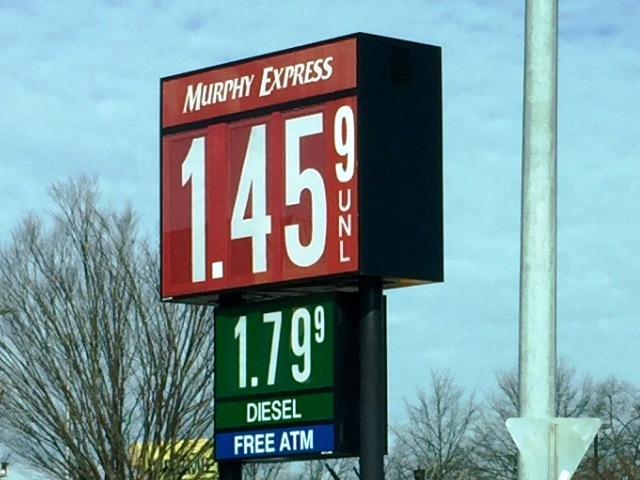
Gas is dirt cheap, because the cost of crude oil has dropped to its lowest in over a decade. The week in the 'Boro began with some discounters offering regular gas for $1.45 per gallon.

It was a few weeks ago that many motorists started wondering if we would see $1.50 gas, now they're asking--is there a chance it could drop below the dollar mark? Some economists note that is possible.
Crude Oil Prices Fall!
Crude oil closed Monday at 32.10 per barrel.
CBS News reports that as oil prices continue to fall, some analysts have suggested that $20 a barrel could be a reality in the near term, said Stifel chief economist Lindsey Piegza in a note.
Despite falling prices and signs the global economy is slowing down, oil companies have kept production steady, seemingly ignoring the basic tenets of supply and demand. The slump in crude prices has taken a toll on the entire energy sector, spurring U.S. shale-oil producers to mothball rigs and energy producers to announce layoffs.
How Long Could Gas Be Cheap?
Many are also now questioning how long oil prices can remain below the $100 a barrel level that was once viewed as the new baseline.

With OPEC in disarray and rising uncertainty about China's economy, research firm Capital Economics revised its forecast for the price of Brent crude, the global benchmark, downward to $45 from $55 a barrel by the end of the year -- about $12 a barrel higher than its trading level on Thursday.
Some industry executives, including Royal Dutch Shell CEO Ben Van Beurden and BP chief Bob Dudley, have also predicted that the decline in oil prices could remain this way for several years.
Love For Car Grows Strong Again
Julian Jessop, Capital Economics global chief economist, expects Brent crude prices to climb to $60 a barrel by 2017 and $70 a barrel by 2020. But "the $100 price for a barrel of oil that many had assumed was the 'new normal' probably won't be seen again in the foreseeable future," he wrote in a note.
The sharp decline in oil prices since last summer hasn't delivered the kind of boost to U.S. consumer spending that many economists had expected. But it helps. Analysts estimate that every 1 cent reduction in prices at the pump puts about a billion dollars in consumers' pockets.
Fuel Efficient Vehicles
It's also potentially a setback for advocates who want to see passenger-vehicle fuel efficiency dramatically increase. Legislation signed into law in 2009, when Chrysler and General Motors were seeking federal bailouts, called on automakers to boost the fuel efficiency to an average 54.5 mpg by 2025. But with automakers making lots of money selling pickups, SUVs and large crossover vehicles, that target now seems under threat.