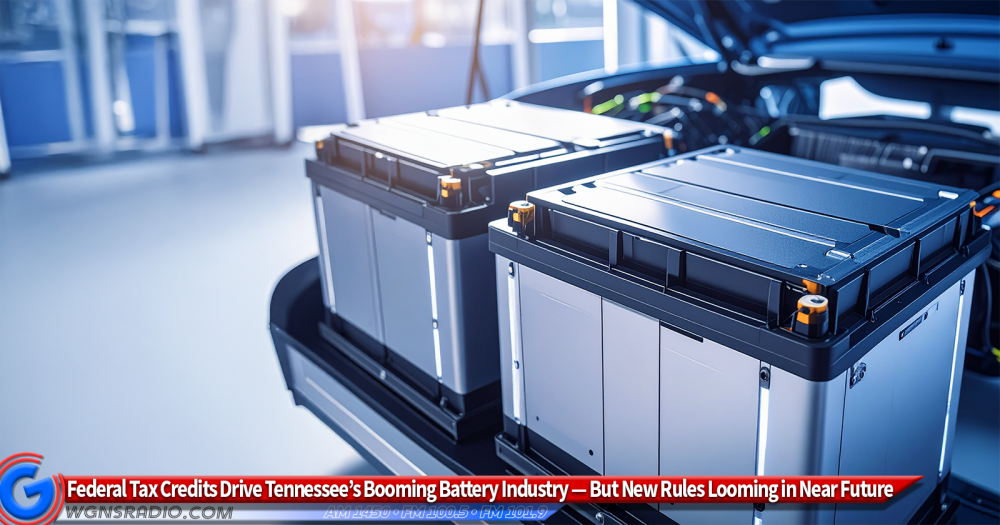
TENNESSEE - Federal tax credits from the Inflation Reduction Act are fueling big growth in Tennessee's battery supply chain. The Volunteer State has become a major hub in battery production with 11 manufactures in the state. For example, LG Chem in Tennessee is investing $1.7 billion into a facility to produce cathode materials for electric-vehicle batteries.

The Volunteer State has attracted more than $5 billion in clean energy investments and created 6,700 jobs since 2022. Major developments include the McKellar Solar Farm in Madison County, which helps power Meta's Gallatin data center and the Sequoyah Nuclear Plant near Soddy-Daisy.
Prior to the "One Big Beautiful Bill" being signed by President Donald Trump on July 4th, Fishman warned the bill would gut key federal tax credits supporting the battery supply chain from EV incentives to energy storage and critical mineral processing. He noted electricity and energy needs are on the rise and the tax credits ensure the energy supply can keep up. Fishman cautioned…
Now that the bill is law, it includes provisions that impact auto battery manufacturing, particularly through changes to Section 45X Advanced Manufacturing Production Tax Credits. These changes affect the availability and phase-out of tax credits for clean energy technologies, including batteries.
MORE DETAILS: The OBBB Act keeps the clean energy investment tax credit (ITC) and production tax credit (PTC) fully available for non-solar and non-wind technologies through 2033, with credits dropping to 75 percent in 2034, 50 percent in 2035, and phasing out entirely in 2036.
But, starting January 1, 2026, these technologies must also comply with the new Foreign Entity of Concern (FEOC) requirements. This could create significant hurdles for battery-related projects since much of the global battery supply chain — including critical minerals and manufacturing — is heavily concentrated in China. If companies are unable to diversify their sourcing and manufacturing away from countries designated as FEOCs, they risk losing access to these valuable tax credits. By comparison, technologies like geothermal may face fewer obstacles because they rely more on domestic supply chains or may qualify for different tax incentives not bound by the FEOC rules. For battery developers, meeting these new requirements will likely require major shifts in procurement strategies, supplier relationships, and investment in domestic capacity.