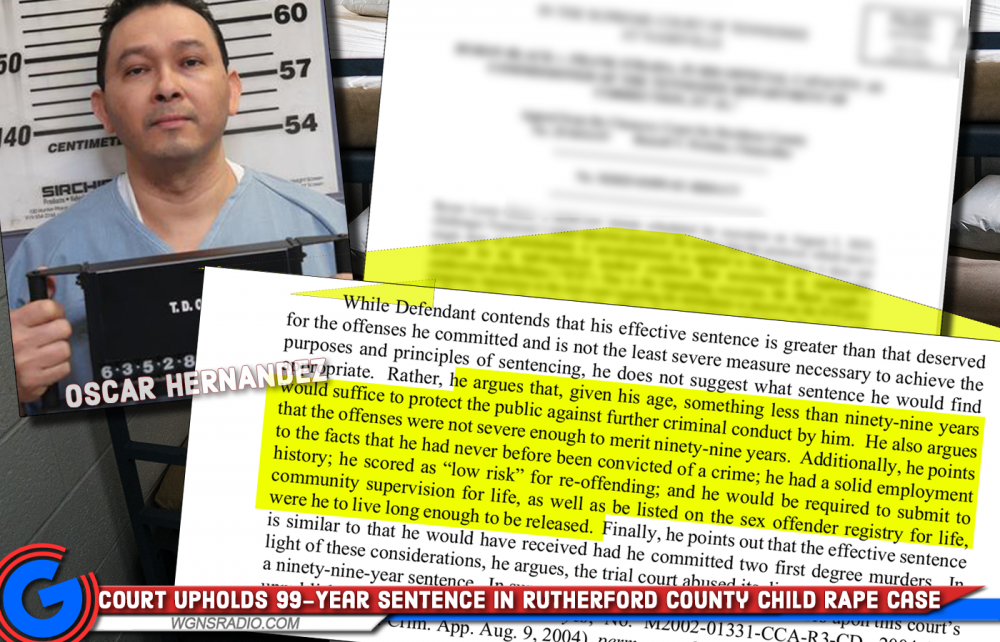
NASHVILLE, Tenn. — The Tennessee Court of Criminal Appeals has affirmed the 99-year sentence of Oscar Hernandez, who was convicted by a jury of three counts of rape of a child and five counts of aggravated sexual battery. The convictions stem from a pattern of abuse involving a minor victim, and the sentence reflects the severity and duration of the crimes.

Hernandez was sentenced to 33 years for each of the rape of a child convictions and 10 years for each of the aggravated sexual battery convictions. The trial court ordered the three 33-year sentences to run consecutively, while the remaining five 10-year sentences were to run concurrently, resulting in a total effective sentence of 99 years, to be served at 100 percent.
At the sentencing hearing, the trial court reviewed evidence including a victim impact statement from the victim’s mother, who described ongoing emotional trauma and the need for psychological therapy. The court identified two enhancement factors for the rape charges: that the crimes were committed to gratify the defendant’s desire for pleasure or excitement, and that Hernandez abused a position of trust to facilitate the offenses. The second factor was also applied to the aggravated sexual battery charges. Although the court acknowledged one mitigating factor—that the conduct did not cause or threaten serious bodily injury—it assigned it little weight.
In justifying the consecutive sentencing, the trial court cited Tennessee law allowing for such sentencing when multiple offenses involve sexual abuse of a minor. The court emphasized the parental relationship between Hernandez and the victim, the year-long span of undetected abuse, and the escalating nature of the acts, which ranged from inappropriate touching to penetration. The court also noted the severe psychological and physical harm suffered by the victim and concluded that an extended sentence was necessary to protect the public from further harm.
On appeal, Hernandez did not contest the individual sentence lengths but argued that the combined 99-year sentence was excessive. He claimed the sentence was disproportionate to his offenses and not the least severe measure necessary. He also pointed to factors such as a lack of prior convictions, a solid employment record, a low risk of reoffending, and the lifetime consequences of sex offender registration and community supervision.
The appellate court, however, disagreed. It noted that Tennessee law only requires one qualifying factor to support consecutive sentencing and found that the trial court had articulated clear and legally sound reasons for its decision. The court also reviewed similar cases where lengthy sentences were upheld under comparable circumstances, emphasizing that the effective length of a sentence is not automatically unreasonable because it exceeds the expected lifespan of the defendant.
The court rejected Hernandez’s reliance on the 2004 State v. Hayes case, which had reduced a defendant’s sentence on grounds of disproportionality, noting that more recent cases consistently upheld long sentences for multiple sexual offenses involving minors. Furthermore, changes in Tennessee’s sentencing law since 2005 have expanded trial courts’ discretion and reduced appellate intervention.
Concluding that the trial court neither abused its discretion nor applied an incorrect legal standard, the appellate court upheld the original judgment. Oscar Hernandez will serve a 99-year sentence without eligibility for early release.

Source: Case No. M2023-01387-CCA-R3-CD