
Middle Tennessee — State officials are issuing a serious public safety warning after the discovery of a highly dangerous substance in the illicit drug supply: Medetomidine. This is evidently a rising concern in a large number of major cities across the country.
The Tennessee Bureau of Investigation (TBI), the Tennessee Department of Mental Health and Substance Abuse Services, and the Tennessee Department of Health report that Medetomidine, a veterinary anesthetic with powerful sedative properties, has recently appeared in crime labs. Officials warn the drug is far more potent than Xylazine and can cause prolonged sedation. Even more concerning, Medetomidine is often found mixed with fentanyl, dramatically increasing the risk of overdose and death.
Officials warn that this is an extremely hazardous and potentially deadly drug, that authorities are strongly urging everyone to avoid it.
An article that was posted to the American Veterinary Medical Association (AVMA.org) website this past June highlighted more details about the illicit medetomidine bulk powder and how it has rapidly emerged as a dangerous adulterant in the U.S. drug supply, frequently mixed with fentanyl or heroin. The article noted how it was first detected in Maryland in 2022, and how it has since spread to several states, contributing to overdose clusters in major cities earlier this year.
While an exact figure of how many overdose cases in Tennessee may be tied to medetomidine, it wasn't until this month that the TBI first officially confirmed the presence of medetomidine in the illicit drug supply and issued a warning of a recent spike in related overdoses.
While medetomidine is FDA-approved only for veterinary use in dogs and other animals, it is not a controlled substance and has no approval for human use.
The CDC Epidemic Intelligence Service Conference highlighted this past March (2025), that in May of last year, the Chicago Department of Public Health was notified of a spike in emergency medical services (EMS) responses for opioid-involved overdoses with atypical symptoms. Toxicology results later showed medetomidine mixed with opioids, marking the first time medetomidine was detected in Chicago. The Windy City was one of the first areas to see such cases last year, with the most common symptoms being hypertension and bradycardia (a slow heart rate).
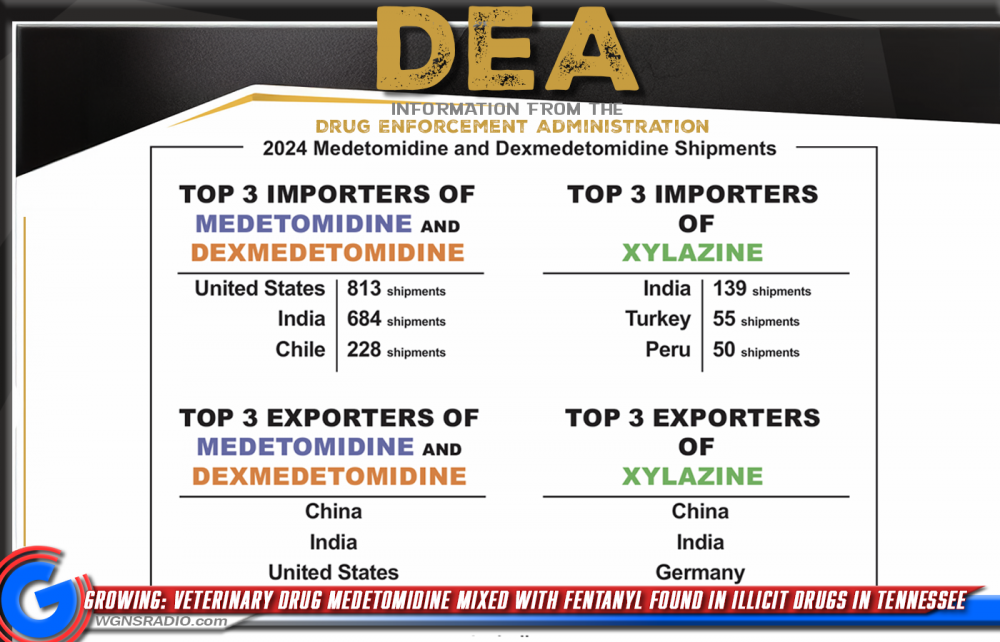
3-DRUGS the DRUG ENFORCEMENT AGENCY TOOK NOTE OF in 2024: Due to the similarities between medetomidine, dexmedetomidine and xylazine — all three are used and sold illegally on the street or are mixed into other illicit drugs and sold illegally.
Medetomidine is used in a similar manner as xylazine in veterinary medicine, and dexmedetomidine in human practice and veterinary medicine — DEA assesses both drugs have the potential to be supplements to or replacements for xylazine in terms of mixing with illicit opioids.
A Drug Enforcement Administration (DEA) report indicated that the rise of medetomidine in the illicit U.S. drug supply began in late 2024. The agency noted that medetomidine and xylazine, another veterinary sedative, are both used in the illegal drug trade and sell in a similar price range of $10 to $300 per kilogram. According to DEA findings, medetomidine first appeared in U.S. drug labs that analyze seized substances in 2021. While medetomidine and xylazine are commonly used by veterinarians, they produce effects similar to dexmedetomidine—a drug approved for use in critically ill human patients.


Overdose Safety Measures
-
If you or someone you know is at risk of overdose, officials recommend keeping naloxone readily available.
-
Free naloxone and training can be accessed through Tennessee’s Regional Overdose Prevention Specialists. More information is available at: TN.gov/behavioral-health/rops.
-
For free, confidential addiction treatment referrals available 24/7, call or text the Tennessee REDLINE at 1-800-889-9789. Treatment is available even for those without the ability to pay.
Officials urge residents to share this informational alert to help protect communities like Rutherford County and across Tennessee.
Medical and public health leaders stress that collective action is necessary to prevent the growing crisis linked to this highly potent veterinary sedative in the illicit drug supply.