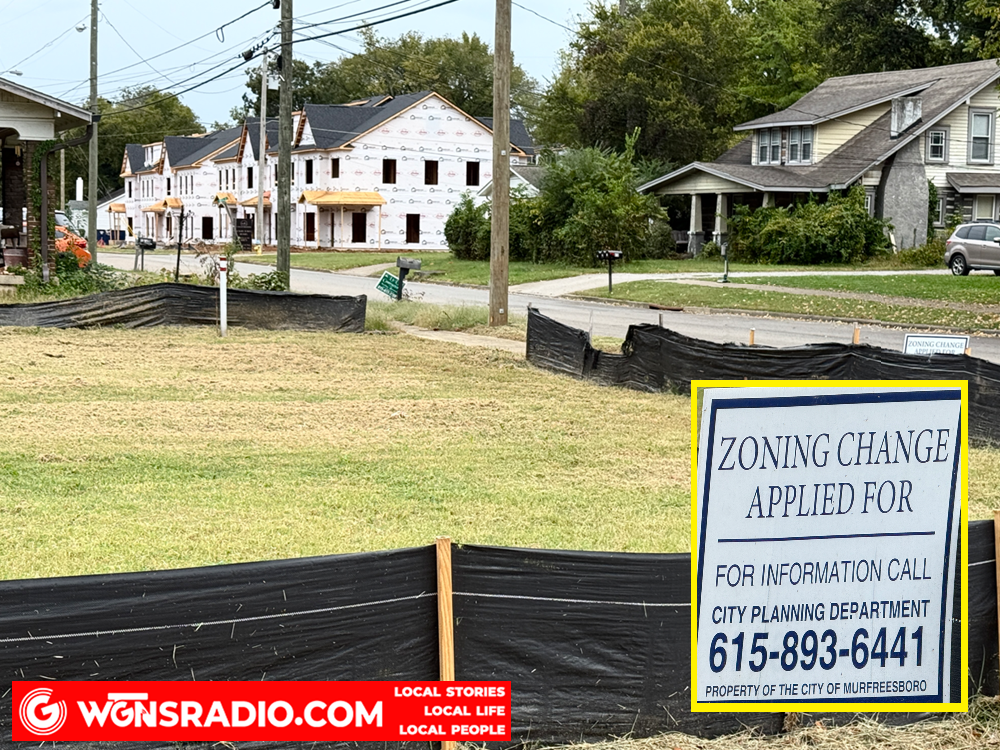
Murfreesboro, TN - Walk through Murfreesboro’s historic downtown district today—especially along North Church, North Spring, and Vine Street—and you’ll see a city in transition. The quiet charm of one-story homes from the 1940s, ’50s, and ’60s is being replaced by towering modern builds, often two to four stories tall, with sleek lines and boxy silhouettes. It’s a visual shift that’s hard to miss, and it’s stirring up conversation about what history we’re preserving—and what we’re letting go.

This isn’t just a Murfreesboro story. Drive through Nashville’s older, upper-income neighborhoods and you’ll see the same transformation. Generation Y, now in their 30s and 40s, is reshaping the urban landscape. With high-paying careers and a taste for walkable neighborhoods near live theatre, trendy restaurants, and vibrant nightlife, they’re investing in homes that reflect their lifestyle. And they’re not shy about going vertical.
But when a three-story modern block-style home rises beside a modest ranch, the contrast is stark. In some areas, the original homes have been replaced so rapidly that the neighborhood’s character feels unfamiliar—even to longtime residents.
That’s where the conversation turns to preservation. What do we save, and how do we save it?
Take the “House of Mayors,” once a well-known Murfreesboro landmark. Its demolition sparked concern, but Rutherford County Historian Greg Tucker says the story is more complicated. “The loss of the ‘House of Mayors’ was hardly sudden or a surprise,” Tucker explained. “It stood vacant and neglected for two decades. The owner priced it above fair value and wouldn’t invest in preservation or utility. I looked at it a couple of times and concluded that at the requested price it would be a $sinkhole.”
Tucker, who owns adjacent properties, watched the situation unfold firsthand. His perspective is clear: preserving history requires more than sentiment—it demands planning, upkeep, and realistic investment. “Sadly, that’s what many ‘keepers of the keys’ of history are not doing.”
So what can be done? Tucker suggests a few practical steps: encourage the use of historic property tax abatements, prepare a written inventory of architecturally significant properties, and organize associations of historic property owners to promote and protect their neighborhoods. After all, the future of any neighborhood is largely determined by those who live in it.
It’s a delicate balance—honoring the past while embracing the future. And as Bob Dylan sang in the ’60s, “The Times They Are A-Changin’.” In Murfreesboro, that change is written in the skyline. After all, beauty lives in the eye of the beholder—and who’s to say which gaze holds the truth?

Preserve Our Local History
.png) Local historian Carol Robertson White is a historian who is active with the Rutherford County Historical Society. She added another bit of history--some is already gone, but another part needs preserving.
Local historian Carol Robertson White is a historian who is active with the Rutherford County Historical Society. She added another bit of history--some is already gone, but another part needs preserving.
Tucked away in the quiet hills of Brookhill, just southwest of Smyrna, lies a patch of ground that holds more than weathered stones—it holds a story of sacrifice, legacy, and the enduring spirit of Rutherford County. The Dewitt-Smith-Jobe Cemetery, named for the Confederate scout whose final act of defiance became legend, rests behind what was once the Jobe family home. (see picture at left) That log house, built around 1833 by Elihu C. Jobe, stood for nearly two centuries before its demolition in 2024. Locals recall the white siding peeled back to reveal the original logs, a haunting glimpse into the past before bulldozers arrived.
Though the home is gone, the cemetery remains—a mix of marked and unmarked graves, many outlined with simple fieldstones. It’s a quiet place, but not forgotten. Descendants and history advocates have rallied to preserve it, recognizing its importance not just as a burial site, but as a living chapter in the county’s Civil War narrative. Dewitt Smith Jobe, a member of Coleman’s Scouts, met a brutal end at the hands of Union soldiers in 1864 after refusing to betray his comrades. His courage, though lesser known than that of fellow scout Sam Davis, is etched into local memory with reverence.
Efforts to restore the cemetery have gained momentum, especially after the loss of the Jobe home stirred public outcry. Cedar logs salvaged from the demolition are being repurposed into memorial pieces, and descendants—some discovered through chance conversations at Ransom—are stepping forward to help. The hope is that the cemetery will not only be protected, but also serve as a place where future generations can learn about the grit and loyalty that shaped this region.
For those who walk its grounds, the silence speaks volumes. Dewitt Jobe may have died in agony, but he rests in honor—on the very land where he was born, among the stones that now tell his story.