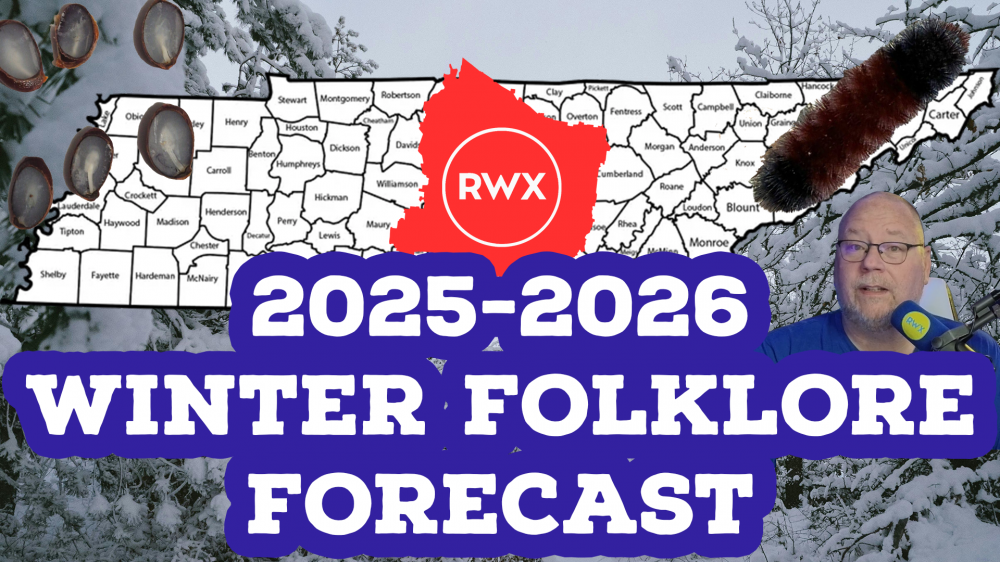

RUTHERFORD COUNTY, Tenn. (WGNS) - As autumn settles across Middle Tennessee, the region’s favorite old-time forecasting traditions are offering their own predictions for the winter ahead — and according to local folklore, this one could be cold and snowy.
From woolly worms to persimmon seeds, nature is said to hold subtle clues about what’s coming. While these signs aren’t scientific, they’ve been trusted by generations of farmers and weather watchers across the South.
Folklore Forecast: Five Signs Point to a Cold, Snowy Winter
To get a sense of what kind of winter might be ahead, we’re turning to five time-honored folklore signs that generations of Tennesseans have trusted: woolly worms, persimmon seeds, August fogs, corn husks, and spider webs. Each one offers a different clue — and this year, they’re all pointing in the same direction.
Woolly Worms Hint at a Back-and-Forth Winter
Tennessee’s woolly worms this fall have been spotted with black bands at the front and back and brown in the middle — a pattern that folklore says points to a winter that starts cold, turns mild midseason, and ends cold again.

Persimmon Seeds Point Toward Snow
In another classic local tradition, persimmon seeds sliced open across Middle Tennessee have revealed more “spoons” than “forks” or “knives.”
According to the saying, spoons foretell snow (“it will spoon a lot of snow on you”), knives mean bitter cold, and forks suggest mild weather. The abundance of spoons this year could mean a snowier-than-usual winter if the old wisdom holds true.
August Fogs Foretell Frequent Snow
Folklore also links the number of foggy mornings in August to the number of winter snows. This year, locals reported around 10 to 15 fogs — which, by tradition, could mean 10 to 15 snow events across the region.

Corn Husks and Spider Webs Signal a Harsh Season
Farmers say that thick corn husks and shucks mean nature is “bundling up” for a hard winter. Many in Middle Tennessee report especially thick husks this year — a possible sign of what’s to come.
Meanwhile, the abundance of heavy spider webs seen in late summer and fall is also said to signal a cold, harsh winter ahead. Some even say when webs stretch across roads or fences, it means snow is on the way.
Folklore Forecast Summary
Put together, the folklore signs — from woolly worms to fogs, persimmons, corn, and webs — all lean toward a cold, possibly snowy winter for Middle Tennessee. But what do the experts say?
Old Farmer’s Almanac Outlook: Mild and Dry
According to The Old Farmer’s Almanac 2025 Winter Forecast, Tennessee can expect a mild and relatively dry winter.
- Temperature: Warmer than normal, with fewer prolonged cold spells
- Precipitation: Drier than usual, meaning limited opportunities for snow or ice
- Pattern: The state sits within a broader region — including Alabama, Mississippi, Arkansas, and Louisiana — expected to experience a calm, quiet winter season
In short, the Almanac’s prediction paints a very different picture than the folklore signs, suggesting that Middle Tennessee will see more jacket days than parka days this year.
La Niña Watch: A Wildcard for Winter
Adding to the mix, the National Weather Service has placed the U.S. under a La Niña Watch, with expectations of a weak La Niña developing this winter.
For Tennessee, that typically means:
- Temperatures: Near or slightly above average, with frequent swings between mild and cold
- Precipitation: Slightly wetter conditions in Middle and East Tennessee, especially late winter
- Snow: Near-normal chances overall, depending on how the jet stream aligns
- Severe Weather: A more active late-winter and early-spring storm pattern is possible, which could bring increased severe weather risk heading into February and March
Bottom Line
If the folklore is right, Middle Tennessee could be in for a return to an old-fashioned winter — cold, snowy, and unpredictable.
If the science wins out, expect a more moderate season, with a few chilly snaps and maybe a flurry or two.
Either way, locals will soon find out which forecast proves true — the one written in the clouds, or the one whispered by nature herself.