
High grocery prices have become one of the most defining economic issues of recent years, influenced by lingering supply chain disruptions, labor shortages, and inflationary pressures. Yet an increasingly powerful—and often overlooked—factor behind rising food costs is the growing impact of natural disasters on the nation’s agricultural production, according to a recently released article by TraceOne.
In April 2025, catastrophic flooding devastated vast sections of farmland across eastern Arkansas, submerging corn, rice, soybean, and wheat fields and damaging roughly 31% of the region’s agricultural acreage, with estimated losses of $99 million. Just months earlier, Hurricane Helene battered North Carolina in late September 2024, prompting the U.S. Department of Agriculture (USDA) to award $221.2 million in federal disaster assistance block grants to help local farmers rebuild.
Across the country, the frequency and intensity of climate-related events such as droughts, floods, and hurricanes are placing unprecedented strain on farmers—and consumers are feeling the effects at the checkout line.
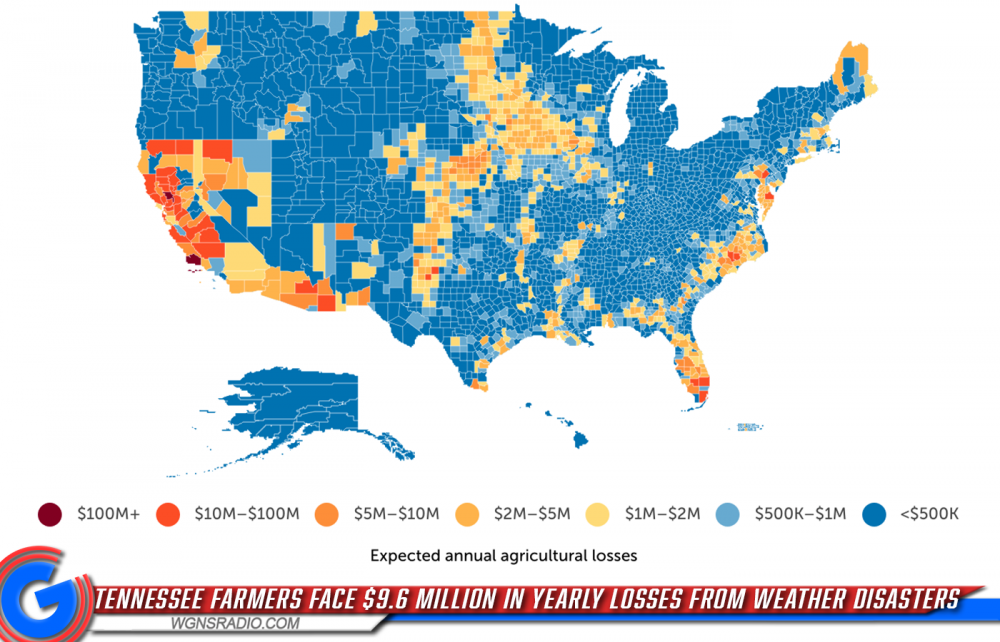
According to research by Trace One, a company specializing in food and beverage product lifecycle management and regulatory compliance, U.S. farms lose an estimated $3.5 billion in agricultural value each year due to natural hazards. Droughts account for the majority of those losses, averaging more than $1,800 per farm. Hurricanes contribute approximately $485 million annually, followed by flooding ($437 million) and cold waves ($286 million).
In Tennessee, farms are projected to lose about $9.6 million each year to natural disasters, averaging $152 per farm. Drought remains the state’s most damaging hazard, reducing irrigation capacity, limiting harvests, and adding stress to livestock operations.
The USDA reports that America’s 1.9 million farms collectively generate $503 billion in crop and livestock value annually. But the escalating toll of natural disasters is reshaping regional agricultural dynamics and threatening long-term food security.
California remains the hardest-hit state, with an estimated $1.3 billion in agricultural losses annually, largely due to drought. Farms in Santa Barbara County alone are expected to lose $245 million per year—by far the largest county-level total in the nation.

Trailing California are Texas ($205 million), Iowa, North Carolina, and Florida, each grappling with unique combinations of droughts, hurricanes, and flooding that have left deep marks on local economies.
For farmers in Middle Tennessee, the challenges may not always make national headlines, but they remain significant. As weather extremes become more frequent, local producers face higher costs for irrigation, crop insurance, and feed, while the price of farmland continues to rise amid population growth and urban expansion.
Despite these hardships, experts say the industry’s resilience—supported by agricultural research, adaptive technologies, and federal disaster relief—remains key to protecting both farms and families from the ripple effects of natural disaster–driven food inflation.
Read More HERE.