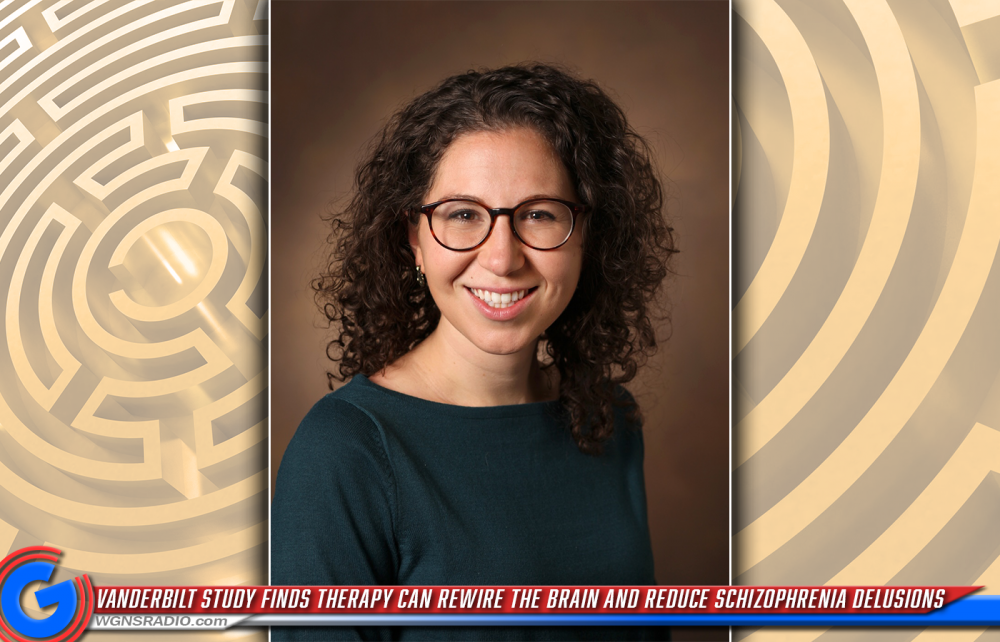
Study: The belief that one’s environment is highly volatile (changes more frequently than it really does) can drive the development of persecutory delusions, a hallmark of schizophrenia, according to researchers at Vanderbilt University Medical Center.

Individual psychotherapy — by reducing hyperactivity in key brain regions — can improve these delusions and other behavioral symptoms of psychosis, they reported recently in the journal JAMA Network Open.
In a randomized clinical trial that assessed the effects of eight weeks of therapy, including cognitive behavioral therapy (CBT) for psychosis, clinical improvement of symptoms occurred even among participants with a 30-year history of schizophrenia.
“There was a change in their brain activation and in their behavior,” said the paper’s lead author, Julia Sheffield, PhD, a clinical psychologist at VUMC. “That to me is very exciting, that therapy for schizophrenia, and for delusions specifically, can help people change their behavior, change their brain.”

Persecutory delusions — beliefs that the world is out to get you — are the most common delusions in individuals with schizophrenia, a severe form of mental illness. They are also among the most difficult to treat.
Sheffield, the Jack Martin, MD Research Professor in Psychopharmacology and assistant professor of Psychiatry and Behavioral Sciences, believes that therapeutic outcomes can improve by focusing on prior expectations of volatility — also called volatility priors.
CBT for psychosis encourages clients to examine beliefs and behaviors that they agree are bothersome, and to test whether their environment is more stable than they thought. The goal is to help them shift and shape prior expectations, so that updated beliefs about safety eventually outcompete persecutory ones.

In the clinical trial, 35 individuals with schizophrenia performed cognitive tasks designed to estimate their volatility priors during functional magnetic resonance imaging of their brains. Reduced brain activity over the course of the study reflected symptom improvement.
The continuing study is part of the Vanderbilt Psychotic Disorders program, which is known for its research excellence and coordinated specialty care.
“Vanderbilt is one of the only places in the country that offers empirically supported treatment specifically designed for persecutory delusions,” Sheffield said.
Vanderbilt co-authors were Ali Sloan, MEd, Baxter Rogers, PhD, Simon Vandekar, PhD, Jinyuan Liu, PhD, Margaret Achee, PhD, Kristan Armstrong, PhD, Neil Woodward, PhD, Aaron Brinen, PsyD, and Stephan Heckers, MD. The study was supported by National Institutes of Health grants K23MH126313 and R01MH127018.