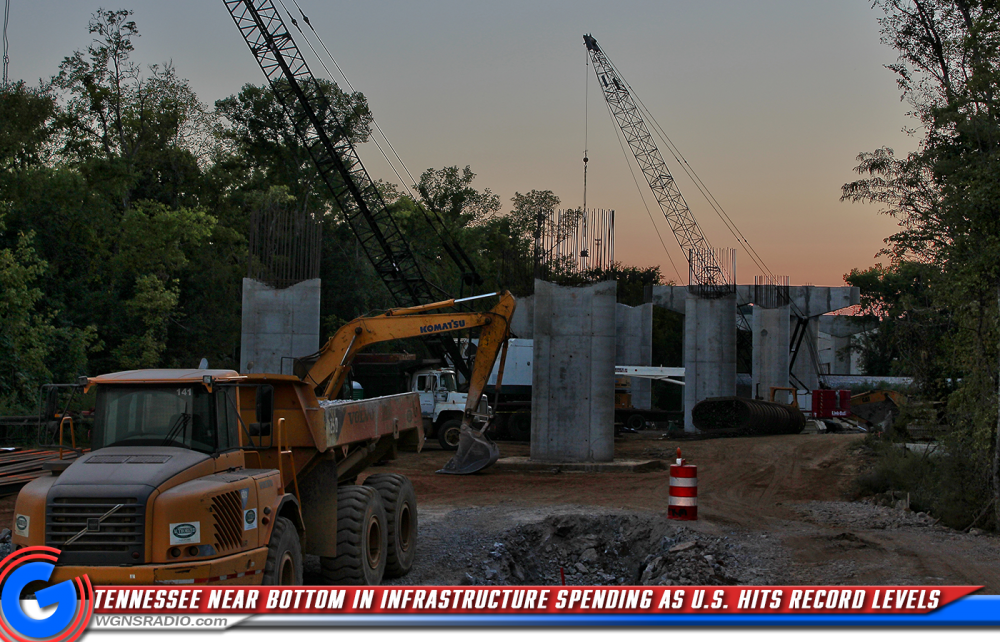
TENNESSEE ROADS: State and local governments across the United States are pouring record levels of money into roads, schools, utilities, and public facilities, marking the highest level of infrastructure spending in more than two decades. But a new 50-state analysis from Twisted Nail shows Tennessee is lagging behind most of the country, investing just $938 per resident in 2024—the fourth lowest rate in the nation.

Keep in mind, just because Tennessee as a whole is behind in road projects and infrastructure improvements, it doesn’t mean every city is falling behind. In places like Murfreesboro, major roadway work and planning continue to move forward on projects that are not controlled by the state. In fact, Murfreesboro has been actively expanding and upgrading its road network and has a long-range plan in place to keep up with the rapid growth seen in recent years, as well as the continued growth expected in the future. Scroll down to bottom of article for more on Murfreesboro's future transportation layouts, diagrams and proposals.
The Twisted Nail study, based on U.S. Census Bureau data, reveals that Tennessee’s state and local governments spent $6.78 billion on public infrastructure projects this year. While that figure has grown 24.3% over the past five years, only 1.3% of that increase remains after adjusting for inflation—far below the 18.6% inflation-adjusted growth seen nationwide.
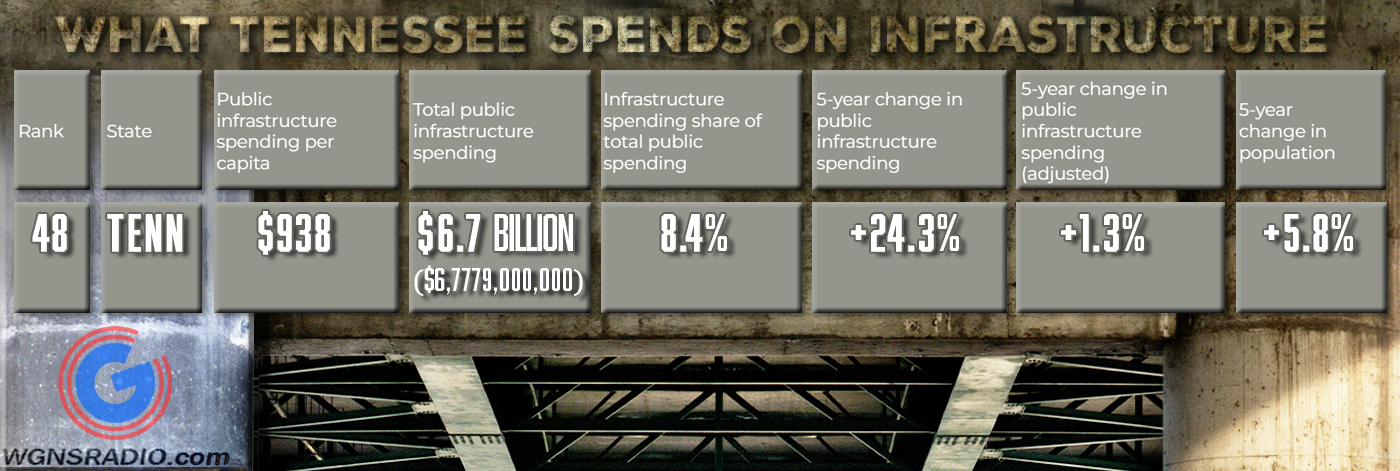
National Spending and More: Nationally, state and local governments invested $463 billion in infrastructure in 2024, averaging $1,361 per resident. More than half of all spending went to transportation systems and educational facilities, while demand for steel, lumber, concrete, and aggregates continues to strain supply chains and drive up costs.
Tennessee vs. National Trends
• Per-capita spending: TN – $938 | U.S. – $1,361
• Total spending: TN – $6.78B | U.S. – $462.8B
• 5-year spending growth (adjusted): TN +1.3% | U.S. +18.6%
• Population growth (5-year): TN +5.8% | U.S. +3.6%
The analysis also confirms that population growth is a major driver of infrastructure demand, with fast-growing states—such as Texas and Florida—seeing major increases in spending. Meanwhile, states like South Dakota and North Dakota lead the nation in per-capita investment, fueled by federal highway and utility funding.

What Projects Are Getting Funded? - Transportation remains the single largest category of infrastructure spending, totaling $141 billion nationally in 2024. Education followed at $110 billion, as cities and counties upgrade aging school buildings and expand capacity for population growth.
But the fastest-growing sectors are power and water systems—both of which doubled or surged significantly in inflation-adjusted dollars over the past five years. Analysts attribute this jump to climate-resiliency upgrades, water-treatment mandates, and increased federal funding through the Infrastructure Investment and Jobs Act (IIJA).
Federal Funding Is Driving the Surge — But It Won’t Last Forever - Much of the recent rise in spending is tied to federal policy. The IIJA authorized $550 billion in new infrastructure funding, but the program phases out beginning in 2026. Without new appropriations, states like Tennessee may face a funding cliff.
At the same time, material costs—particularly steel, aggregates, and equipment—continue to rise, and the construction industry is short an estimated 500,000 skilled workers, according to Associated Builders and Contractors. Both factors threaten to delay or downsize future projects.
The Bottom Line - Tennessee’s infrastructure spending is growing—but not fast enough to keep pace with national trends, population demand, or inflation. As federal dollars begin to taper off and construction costs rise, state lawmakers may face difficult budget decisions about roads, utilities, and public facilities.
The full 50-state analysis from Twisted Nail is available now and includes rankings, five-year trend data, and sector-specific breakdowns. Scroll Below for Murfreesboro's 2040 map to the future.

Murfreesboro 2040 Road Plans and More: The City’s 2040 Major Transportation Plan is a long-term guide that helps Murfreesboro decide where future roads should go as the city grows. It’s not just a list of roads to build soon, but a way to protect space for future transportation needs, even many years from now. The plan explains that roads in the future may look and function differently than they do today, and some projects may not be built for decades, depending on growth, funding, and community priorities. Many of the road ideas are still only sketches, not exact routes, and the final details will be decided later during design and engineering. The plan was created with public input through meetings held in all four parts of the city, and was then presented to the City Council in 2017.
MURFREESBORO REPORT on the 2040 Major Transportation Plan: The 2040 Major Transportation Plan is a long-range plan that identifies the location and type of roadway facilities that are needed to meet the projected long-term growth within the city limits of Murfreesboro. The Plan is not simply a list of road construction projects, but rather it is a tool to enable the City to preserve future corridors for transportation system developments as those needs arise. Future changes in technology, cost, service demands, growth patterns and long-term economic shifts require us to take a farsighted approach to transportation planning decisions.
There are two key concepts to remember when reviewing the projects proposed within the 2040 Major Transportation Plan. First, the future will look different than today. Existing roadways are categorized in the plan according to their anticipated future function, which may not be the same function that they currently serve. Some of the proposed roadways may not be constructed for many years, if not decades, if ever. The timing of construction will depend on a myriad of factors including actual development activities, priorities set by the community and elected officials, and available capital and other resources. Second, many of the proposed routes are conceptual only. For long-term planning purposes, proposed roadways are often presented as conceptual alignments; meaning that they are not intended to reflect exact routes. Actual construction and specific routes will be determined much later through preliminary engineering and design activities.
The 2040 Major Transportation Plan was developed and public meetings were held in each of the 4 quadrants of the City to engage citizen feedback. The City's engineering consultants on this project, Neel-Schaffer, provided a Powerpoint presentation and a list of proposed projects to City Council in August 2017.
Below are links to these documents as well as links to the FINAL 2040 Major Transportation Plan and the 2040 MTP GIS Map.
Diagrams and Details on Murfreesboro's plans that take us into 2040:
- 2040 Major Transportation Plan - Presentation by Neel-Schaffer (PDF) (2017)
- 2040 Major Transportation Plan - Draft Projects proposed by Neel-Schaffer (PDF) (2017)
- Diagrams and Maps of 3 to 5-Lane Plans: 2040 MTP GIS Map
- A Closer Look at Murfreesboro 2040: FINAL 2040 Major Transportation Plan
- Visit the Murfreesboro website to learn more about transportation plans HERE.