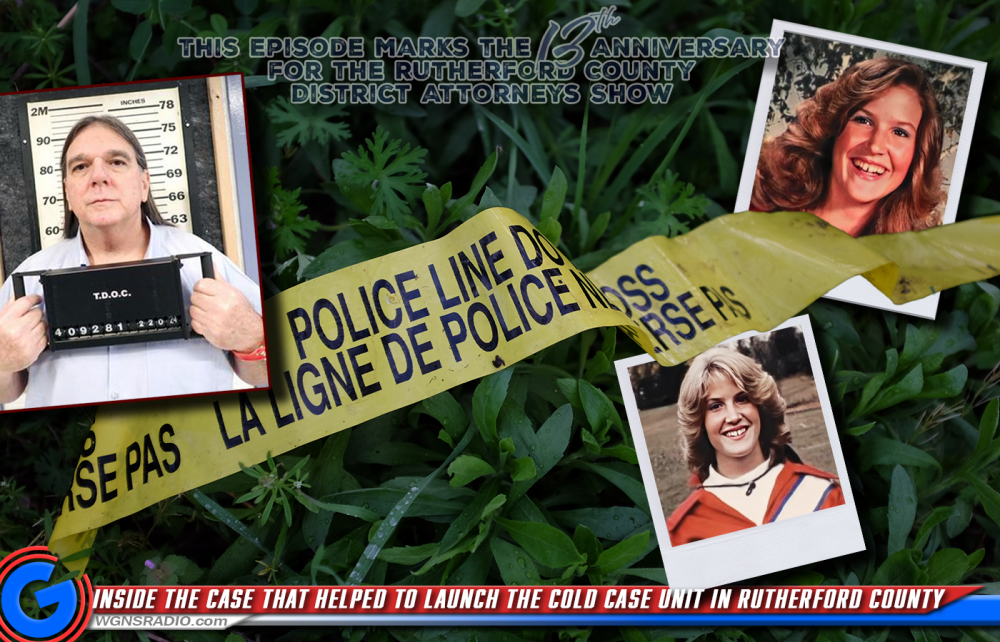
RUTHERFORD COUNTY, TN - During this episode of the Rutherford County District Attorney’s Show on of the WGNS Action Line, host J. Paul Newman marks the 13th anniversary of the monthly broadcast by revisiting one of the most significant criminal investigations in local history — the 1984 murder of MTSU student Laura Salmon. Once considered a cold case, the investigation was reignited in 2002 and ultimately led to the conviction of David Kyle Gilley, helping set the foundation for the first Cold Case Homicide Unit in Rutherford County under former Sheriff Truman Jones (retired).

Retired Rutherford County Sheriff’s Detective Dan Goodwin, one of the lead investigators who helped to bring the case back to life, joins Newman to share behind-the-scenes details, investigative breakthroughs, and how the case reshaped local law enforcement procedures.
Also on the podcast, Assistant District Attorney Trevor Lynch provides updates on several current major cases, including ongoing murder trials and recent convictions affecting Rutherford County.
A compelling blend of history, justice, and local legal insight — this episode honors 13 years of holding the microphone to truth in the courtroom.
More About the Murder of Laura Salmon - At age 59, David Kyle Gilley is serving a life sentence for the 1984 murder of Laura Salmon, a case that went unsolved for nearly two decades. Although the murder occurred when Gilley was 17, he was not arrested until 2001, after investigators reopened the case and located him in a small town in Florida. He was convicted in 2006 — 22 years after the crime — following a series of legal challenges both before and after trial, most of which were later viewed as minor attempts to delay prosecution.
According to the Tennessee Department of Correction, Gilley will not be eligible for parole until 2042, two months after his 76th birthday.
The case was initially difficult to pursue because, in the 1980s, investigators lacked the evidence needed to make an arrest. The breakthrough came when Gilley was in his mid-thirties, after Rutherford County Sheriff’s Office detectives re-examined the case, reviewed old evidence, and conducted new interviews. That work led to witness testimony and DNA results that tied Gilley directly to the crime scene.
Laura Salmon was only 18 years old when she was killed, just nine months and eight days older than Gilley. Because the murder happened just six weeks and two days before his 18th birthday, Gilley was initially charged as a juvenile. However, due to the violent nature of the crime and the documented pattern of domestic abuse in their turbulent relationship, he was ultimately transferred and tried as an adult.

Some of the Obstacles Rutherford Co. Detectives and the State Faced:
2003 - 2004: In this 2004 interlocutory appeal, the Tennessee Court of Criminal Appeals reviewed a trial court’s decision about what evidence could be used against David Kyle Gilley, who was charged with the 1984 murder of Laura Salmon. The dispute centered on whether prosecutors could introduce testimony about Gilley’s past violent behavior toward Salmon and others under Rule 404(b), which governs “prior bad acts” evidence. The court ultimately affirmed some portions of the trial court’s ruling, allowing testimony that showed a pattern of abuse relevant to motive, intent, and the hostile relationship between Gilley and the victim, but reversed other portions, ruling that decisions about “cumulative” testimony could not be made before trial. The case was sent back to the lower court for further proceedings, keeping many witness accounts admissible but requiring closer examination during trial. Click Here to see the 2203-2004 related court documents (PDF)
2005: The Tennessee Supreme Court ruled that the lower courts made a mistake by allowing an early appeal about what evidence could be used in the upcoming trial of David Kyle Gilley, who was charged with the 1984 murder of Laura Salmon. The issue centered on whether the State could use evidence of Gilley’s past acts of physical abuse toward the victim and others. The Court of Criminal Appeals had said such evidence was automatically allowed, but the Supreme Court disagreed, explaining that prior bad acts are not automatically admissible and must first meet the safeguards in Rule 404(b), which require proving the evidence is relevant, necessary, and not overly prejudicial. The Supreme Court reversed the earlier ruling and sent the case back to the trial court to properly review the evidence under the correct legal standards. Click Here to see the 2005 related court documents (PDF)