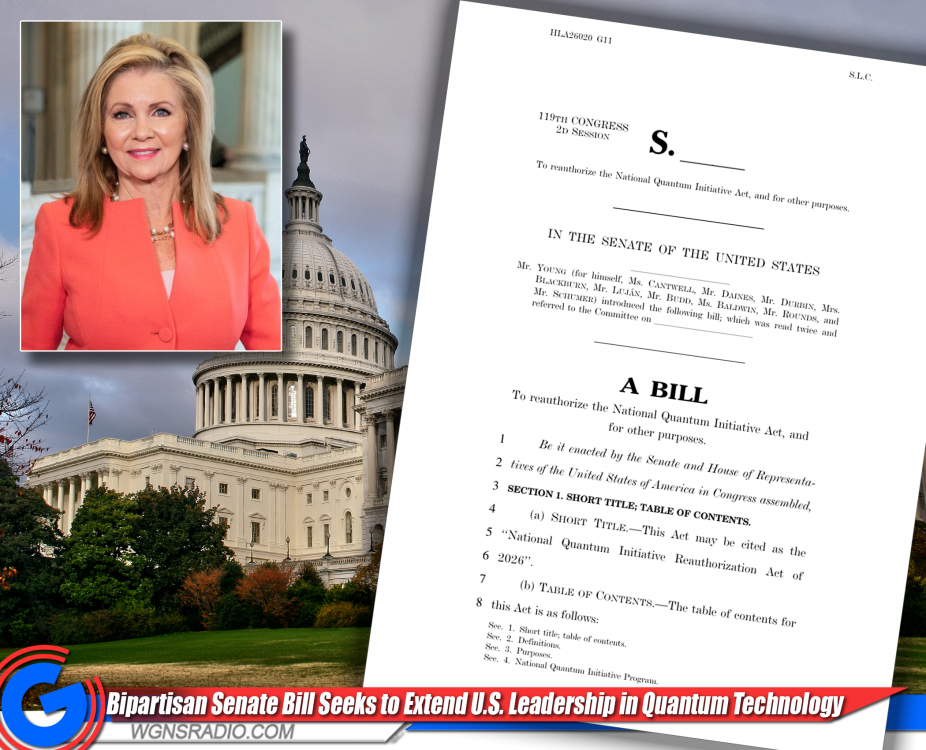
WASHINGTON, D.C. — A bipartisan group of U.S. senators has introduced legislation aimed at strengthening America’s leadership in quantum technology and ensuring long-term competitiveness in the global technology race. The National Quantum Initiative Reauthorization Act would extend federal support for quantum research and development for an additional five years, continuing programs first established under the original National Quantum Initiative.

The bill is led by U.S. Sen. Marsha Blackburn of Middle Tennessee, Todd Young, and Maria Cantwell, and is co-sponsored by seven additional senators from both parties. Supporters say the legislation is designed to ensure the United States remains at the forefront of quantum computing, sensing, communications, and related emerging technologies amid growing international competition.
“I’ve worked for years to reauthorize the National Quantum Initiative, and I’m pleased to join my colleagues in introducing a bill that will ensure America will dominate the global quantum race. Tennessee will play a critical role in making certain we do not fall behind adversaries like Communist China,” Blackburn said. “The National Quantum Initiative Reauthorization Act would reauthorize quantum programs to accelerate innovative quantum research, protect our national security, and advance President Trump’s goal of American quantum supremacy. We must pass this without delay and incorporate my quantum bills focusing on quantum manufacturing and near-term uses.”
Young emphasized the strategic importance of workforce development and research capacity, stating, “We need to ensure the United States has the talent and research capabilities required to lead the global tech competition and outcompete China. Quantum technologies promise to dramatically transform every industry and sector of our economy and revolutionize our technological capabilities.” He added that the legislation is critical to safeguarding both economic and national security.
Cantwell highlighted the practical applications of quantum technology, noting its potential impact across sectors ranging from healthcare to clean energy. She said federal investment is essential to accelerating the transition from basic science to real-world innovation, adding that the bill positions the United States to drive economic growth, strengthen domestic supply chains, and create high-skilled jobs.
According to the legislation, the National Quantum Initiative would be extended through December 2034. The bill directs the White House Office of Science and Technology Policy to develop an international quantum cooperation strategy with U.S. allies, while also strengthening safeguards against foreign adversaries. It expands directives to move quantum research toward practical applications and requires federal agencies to develop performance metrics and regularly report progress to Congress.
The measure also authorizes funding for multiple federal agencies, including the National Institute of Standards and Technology, the National Science Foundation, and NASA. Provisions include the creation of new multidisciplinary quantum research and education centers, workforce coordination hubs, prize challenges to spur innovation through public-private partnerships, and initiatives to improve the resilience of domestic quantum supply chains.
In addition, the bill calls on the Government Accountability Office to study regulatory and administrative barriers that may hinder private sector and academic participation in federal quantum programs. Supporters say reducing unnecessary red tape will be key to accelerating innovation and maintaining U.S. leadership.

The National Quantum Initiative Reauthorization Act of 2026 was formally introduced in the U.S. Senate and referred to committee for consideration.