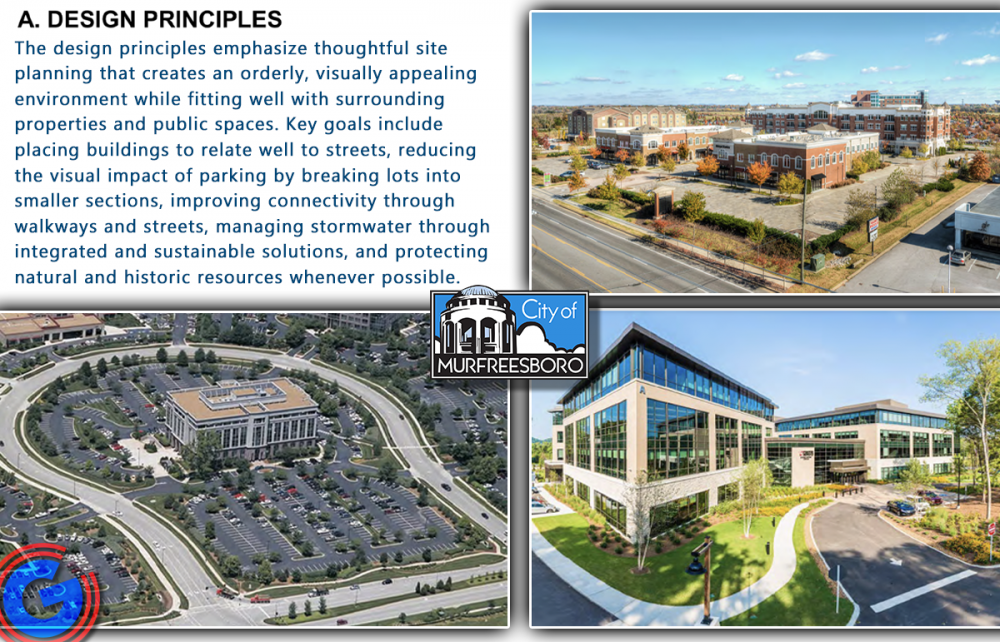

MURFREESBORO, Tenn. — If Murfreesboro is going to keep growing — and all signs say it will — city leaders agree it should probably do so with a little more intention than “just put it there and add parking.” That theme seemed to have guided the discussion during a recent joint conceptual workshop between Murfreesboro City Council and the Planning Commission, where proposed updates to the city’s long-awaited Design Guidelines were presented and debated. The revised draft, updated in December 2025, outlines how future development should look, feel, and function as the city continues its rapid expansion.
The guidelines are not about freezing Murfreesboro in time or telling architects what color brick they must use. Instead, city staff and consultants described them as a framework — one aimed at improving streetscapes, strengthening pedestrian connections, reducing visual clutter, and preserving what officials repeatedly refer to as the city’s “sense of place”.
Among the most discussed elements were public street design and connectivity, which emphasize safer, more walkable streets that accommodate pedestrians, bicycles, vehicles, and transit — sometimes all at once. The guidelines promote wider sidewalks, better crosswalks, traffic-calming features such as roundabouts and curb extensions, and street layouts that connect developments rather than funneling everyone onto already crowded arterials.
Parking, a topic that reliably sparks debate, also received attention. The revised guidelines discourage large, uninterrupted “seas of parking” in favor of smaller lots broken up by landscaping, pedestrian paths, and stormwater features. The idea is to make parking functional without letting it dominate every view — a subtle but noticeable shift from past development patterns.
The document also places a strong emphasis on building orientation and site design, encouraging structures to face public streets, hide service areas and dumpsters, and better integrate with surrounding neighborhoods. For redevelopment, infill, and adaptive reuse projects, the guidelines allow flexibility — acknowledging that not every older site can meet modern standards without some creative problem-solving.
City leaders stressed that the guidelines are intended to balance growth with long-term livability. As Murfreesboro continues to attract new residents, businesses, and investment, officials say thoughtful design will play a key role in maintaining property values, improving safety, and ensuring the city doesn’t lose its character in the process.
The workshop marked another step toward potential adoption of the revised Design Guidelines, which will continue moving through review by staff, the Planning Commission, and City Council. Public input is expected to remain part of the process — because if there’s one thing Murfreesboro residents care about almost as much as growth, it’s how that growth looks when it arrives.

- See more guidelines and information on the guidelines HERE.