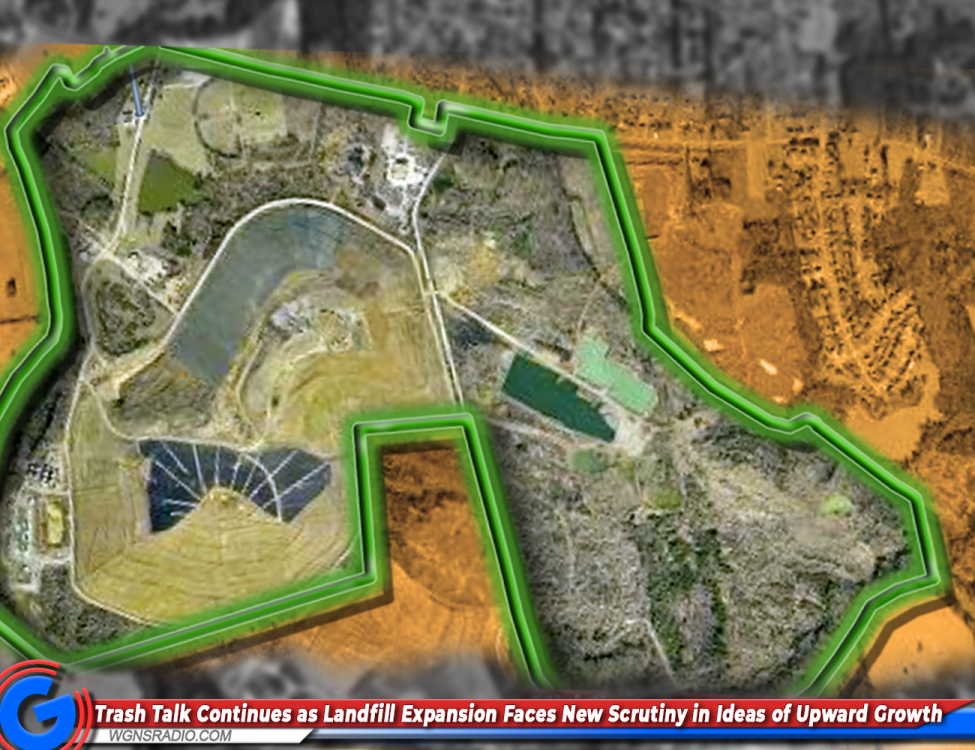

MURFREESBORO, Tenn. — A long-running dispute over the future of the Middle Point Landfill reached a significant turning point this week, as a Davidson County Chancery Court judge ordered state regulators to halt review of a proposed vertical expansion that would have dramatically increased the landfill’s size and lifespan.
The ruling handed down by the court grants the City of Murfreesboro a writ of mandamus (Latin for “we command”), directing the Tennessee Department of Environment and Conservation (TDEC) to stop processing an application filed by BFI Waste Systems of Tennessee, a subsidiary of Republic Services, for a vertical expansion of the Middle Point Landfill.
Under the proposal, landfill operators sought to add roughly 70 feet of new waste height on top of the existing mound, increasing capacity by an estimated 19 million tons and extending operations through 2046. City officials argued that BFI attempted to bypass required local and regional review by submitting its application directly to TDEC, rather than first seeking approval from the regional solid waste board, as mandated under the Solid Waste Management Act.
The City filed suit in December, asking the court to halt TDEC’s review until BFI complied with statutory requirements, including a regional board review and a public hearing to allow citizen input. After reviewing the complaint, the court ordered TDEC to cease processing the application, effectively putting the proposed vertical expansion on hold.
Officials with the City also suggested the landfill operators tried to gain approval through TDEC by classifying the vertical request as a major modification rather than an expansion.
State Representative Bryan Terry stressed that “going vertical is still an expansion.” He highlighted such moves as attempts to skirt the system... Representative Terry represents the north end of Rutherford County, which is where the landfill is located.
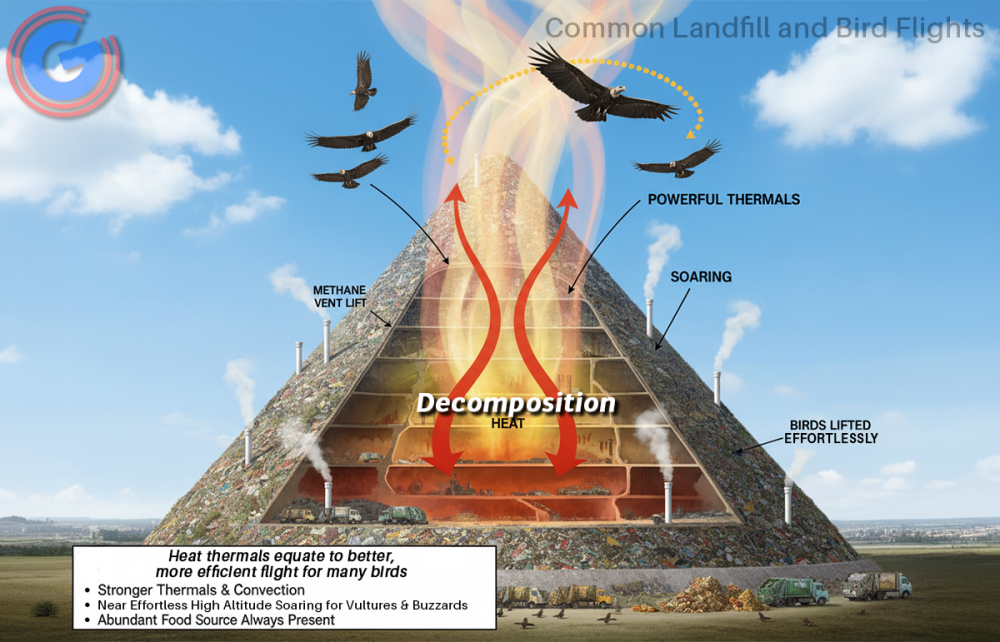
As the representative pointed out, problems with a height increase are not solely local... Terry told WGNS News that the idea of the landfill reaching new heights is a concern for area flights... As a mound of waste grows taller, so does the number of circling vultures and buzzards. A higher landfill can actually become more attractive to birds than a lower one due to thermals.

What many fail to realize is that when a landfill grows taller, the thermal updrafts become stronger. As a landfill increases in height, it becomes warmer and creates stronger thermal updrafts. Stacking waste increases heat from natural biological and chemical decomposition, and methane released during this process rises into the air, forming man-made thermals. These rising air currents make it easier for birds to gain altitude and travel long distances with little effort.
Even with landfill gas (LFG) energy systems in place, this heat cannot be eliminated. While gas collection systems capture much of the methane, they do not stop the decomposition inside the landfill that continues to produce heat and rising air. As a result, thermal updrafts remain.
Vultures and buzzards are built for high-altitude flight and take advantage of these conditions. Warm, rising air is less dense, allowing large birds to glide efficiently instead of flapping their wings, which requires more energy. Taller, warmer landfills therefore make flying easier and more efficient for scavenging birds.
A matter of days ago, Rep. Terry was informed that the application submitted to TDEC was incomplete (See previous article HERE).
He has also pointed to what is commonly referred to as the “Jackson Law,” which governs how landfill expansions in Tennessee counties must be reviewed.
The “Jackson Law” (T.C.A. § 68-211-701 et seq.) in Tennessee is a statute adopted in 1989 allowing county or municipal legislative bodies to approve or block the construction or expansion of most new private landfills and solid waste processing facilities. It requires a two-thirds vote to adopt, providing local oversight before state permits are issued.

The obstacle that stands in the way of the Jackson Law and Rutherford County is contracts...
Murfreesboro and the Recent Ruling: City of Murfreesboro officials say the recent ruling reinforces their longstanding position that any expansion—upward or outward—must be subject to local oversight and public scrutiny. In its court filings, Murfreesboro also cited ongoing environmental concerns tied to the landfill. According to the City, recent testing connected to a pending federal lawsuit shows continued discharges of landfill leachate into the East Fork Stones River, a critical drinking water source for both Rutherford County and Murfreesboro residents, raising potential Clean Water Act and Clean Air Act issues.
Landfill operators have maintained that modifying and expanding the facility is a standard industry practice necessary to meet Middle Tennessee’s waste-disposal needs, and that any permit request would be subject to extensive review and public comment if approved. Supporters argue that without additional capacity, the region could face higher disposal costs and logistical challenges.
Critics, however, counter that increasing the landfill’s height amounts to stacking garbage rather than solving the region’s long-term waste problem. They continue to urge investment in alternatives such as recycling, diversion programs, transfer stations, and reduced reliance on a single, massive landfill.
The broader conflict over Middle Point is not new. Previous attempts to expand the landfill laterally were denied by the regional board, and a 2024 court ruling upheld that denial. Murfreesboro and Rutherford County leaders have repeatedly voiced opposition to any expansion, citing environmental risks and quality-of-life concerns for nearby communities.
With the court now ordering TDEC to halt its review, the future of the Middle Point Landfill remains uncertain. Whether the proposal ultimately returns to the regional board, is reworked, or gives way to alternative waste-management strategies, the outcome will carry major environmental, economic, and political implications for Rutherford County and beyond.
Summary Regarding Recent Order: A Davidson County Chancery Court judge has ordered the City of Murfreesboro to prevail in its effort to stop a proposed vertical expansion of the Middle Point Landfill. The court granted the City a writ of mandamus, directing the Tennessee Department of Environment and Conservation (TDEC) to immediately halt its review of an application submitted by BFI Waste Systems of Tennessee.
The court found that BFI attempted to bypass required procedures by filing directly with TDEC instead of first submitting the proposal to the regional solid waste board, which would have triggered local review and a public hearing. The proposed expansion would have added a 70-foot-high mound of waste on top of the existing landfill, increasing capacity by an estimated 19 million tons.
Murfreesboro officials argued that the application violated the Solid Waste Management Act and raised serious environmental concerns. The City cited ongoing issues in a separate federal lawsuit, including alleged continued violations of the Clean Water Act and Clean Air Act tied to landfill leachate discharges into the East Fork Stones River, a drinking water source for local residents.
As a result of the ruling, TDEC must stop processing the application unless and until BFI complies with required regional review and public input procedures.
Summary of Birds Flying Over Taller Landfills: A taller landfill heats up more and creates stronger rising warm air (thermals). These thermals lift vultures and buzzards upward, allowing them to soar higher with little effort. Methane vents add extra upward air movement. Because food is always present and the birds are built for high-altitude flight, a higher landfill makes it easier—not harder—for birds to gain height and glide.
Click Below Photo for Previous Article: