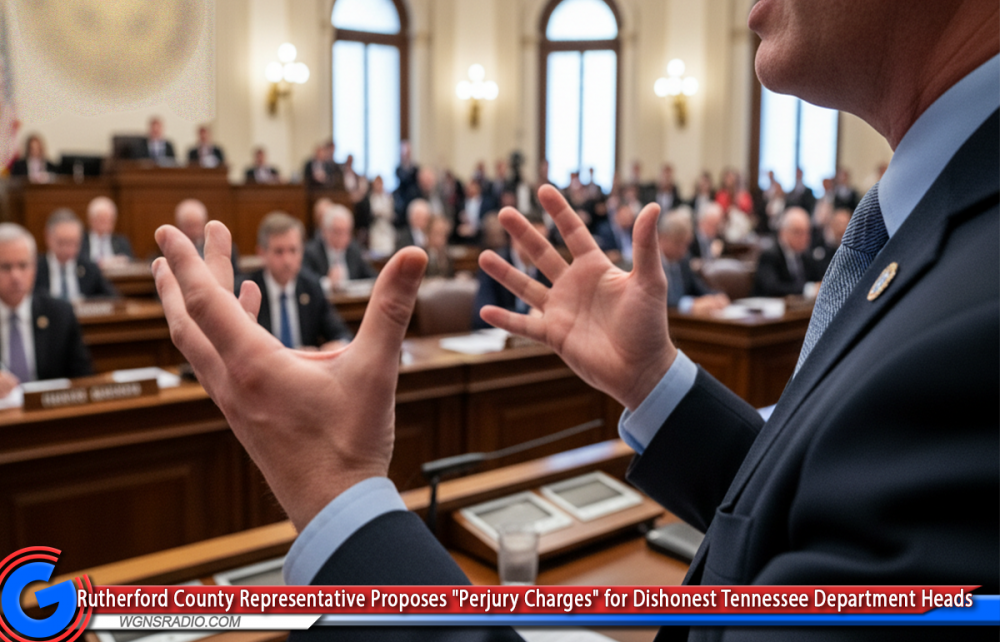
RUTHERFORD COUNTY, TN (WGNS) - In the State of Tennessee, the process of lawmaking is a high-stakes environment where various state departments—ranging from the Department of Education to the Department of Correction—often act as both administrators and defensive strategists. When a bill is introduced at the Nashville Capitol that could slash funding, alter employee counts, require additional duties, or overhaul operations, these agencies utilize a sophisticated internal "radar" to respond before the ink on a proposed measure is even dry.

To decide what is important or what may be a priority for the department in question, officials do not wait for local media outlets to report on bills being drafted by elected leaders. Instead, many departments under the state government deploy their secret weapon—commonly referred to as a Legislative Liaison or lobbyist—to the State Capitol to actively monitor meetings and hearings. Departments also send these chosen liaisons to the Capitol to conduct in-office visits with elected state representatives and senators. These liaisons are dedicated professionals paid to work specifically for the department that hired them; their sole job is to monitor the Tennessee General Assembly for proposed bills or law changes that could impact their respective agencies.
The plot thickens when department heads are asked to speak before committees and subcommittees. Requests for these state executives to testify are sometimes made through the department's dedicated liaison, while at other times, the head of the office is asked directly by an elected lawmaker. Adding a new piece to this political puzzle, State Representative Tim Rudd (R-Murfreesboro) told WGNS News that when department heads show up to speak at a hearing, they are not always on the up-and-up...
Proposed laws, additional resource requests, and funding often hinge on the honest testimony provided to lawmakers. In many situations, elected representatives push to implement changes for the betterment of taxpayers, but Representative Rudd admits that legislation changes or policy upgrades are difficult to pass when they are fed information that raises more questions than answers... Verifying dollar amounts or statistics provided by department heads has proven to be even more challenging for elected leaders...
Representative Rudd stated that the pattern of deception continues...Due to these concerns, he has introduced House Bill 1698 (and its companion Senate Bill 1721), which would allow for criminal charges to be filed against department heads who do not tell the truth while testifying... As introduced, House Bill 1698 authorizes committee chairs to require an executive branch employee to take an oath prior to testifying. If it is realized that the subject lied under this oath, they could face perjury charges, specifically classified as a Class C misdemeanor.
When testimony is given, Rudd’s bill also authorizes the chair of a committee or the Executive Director of Fiscal Review to require that specific documentation be submitted by the department employee for evaluating a legislative measure. The employee may also be required to submit a sworn affidavit attesting to the accuracy of that documentation. If a study of these documents proves the department spokesperson intentionally lied, they would be subject to the penalty of perjury.
In the House, the bill has been assigned to the Public Service Subcommittee. The Senate version, SB 1721, is currently being considered by the Senate State and Local Government Committee.

Summary of the Proposed Bill Below (Click Here to Read the More Detailed PDF) The following summary details the fiscal and legislative implications of SB 1721 / HB 1698 (Click the bill number to the left to read the actual bill), as analyzed by the Fiscal Review Committee of the Tennessee General Assembly:
Bill Summary
-
Testimony Under Oath: Legislative committee chairs are authorized to require executive branch employees to provide material statements under oath or affirmation.
-
Fiscal Affidavits: The Executive Director of the Fiscal Review Committee (FRC) can require executive branch employees to sign an affidavit attesting to the accuracy of materials submitted for fiscal impact analysis.
-
Penalties for Deception: The bill establishes a Class C misdemeanor offense for perjury for individuals who violate these requirements with the intent to deceive.
-
Reporting Suspicion: If a committee chair or the FRC Executive Director suspects an employee has submitted false materials, they must provide written notice to specified individuals.

-
Investigation and Prosecution: The Speaker of either chamber may initiate an investigation. If sufficient evidence is found, the individual may be referred to the District Attorney General for prosecution.
Fiscal Impact
-
Overall Impact: The fiscal impact is determined to be not significant.
-
Convictions: The analysis assumes executive branch employees will comply with the law, resulting in zero new convictions for the Class C misdemeanor.
-
Operational Costs: Any investigations or local expenditures related to potential incarcerations are expected to be handled using existing resources and will not significantly affect state or local government operations.
5 Recent Situations of Departmental Testimony (2024–2026)
1. The Department of Children’s Services (DCS) & Caseload Funding
In recent sessions, DCS leadership has repeatedly testified before the House and Senate Health Committees. Facing a crisis of children sleeping in office buildings, the department head was sent to testify about the desperate need for more case manager positions. They argued that without a massive influx of tax dollars to raise salaries, they could not meet legal safety requirements.
2. Department of Correction & Private Prison Costs
During debates over the state’s budget for private prisons (like those run by CoreCivic), Department of Correction officials have been grilled in the Finance, Ways, and Means Committee. Lawmakers questioned why the department was requesting more funds while staffing levels remained dangerously low.
3. Department of Education & The Voucher Debate
With the "Education Freedom Scholarships" (vouchers) being a major 2024-2025 focus, Department of Education officials testified about the "fiscal neutrality" of the bill. They had to explain to skeptical lawmakers how moving tax dollars to private schools wouldn't "starve" local rural districts of their per-pupil funding.
4. Department of General Services & Construction Delays
In a late 2025 hearing, the State Building Commission and Department of General Services were called to testify about why 11 major taxpayer-funded projects (approved in 2024) had not yet "broken ground." The department had to defend its delivery methods against claims of bureaucratic "red tape."
5. Department of Transportation (TDOT) & The Choice Lanes
TDOT leadership recently testified regarding the "Build With Us" act, specifically about the funding shift toward "Choice Lanes" (tolled express lanes). They were forced to testify on whether this would prioritize wealthy commuters over the maintenance of existing rural state roads.