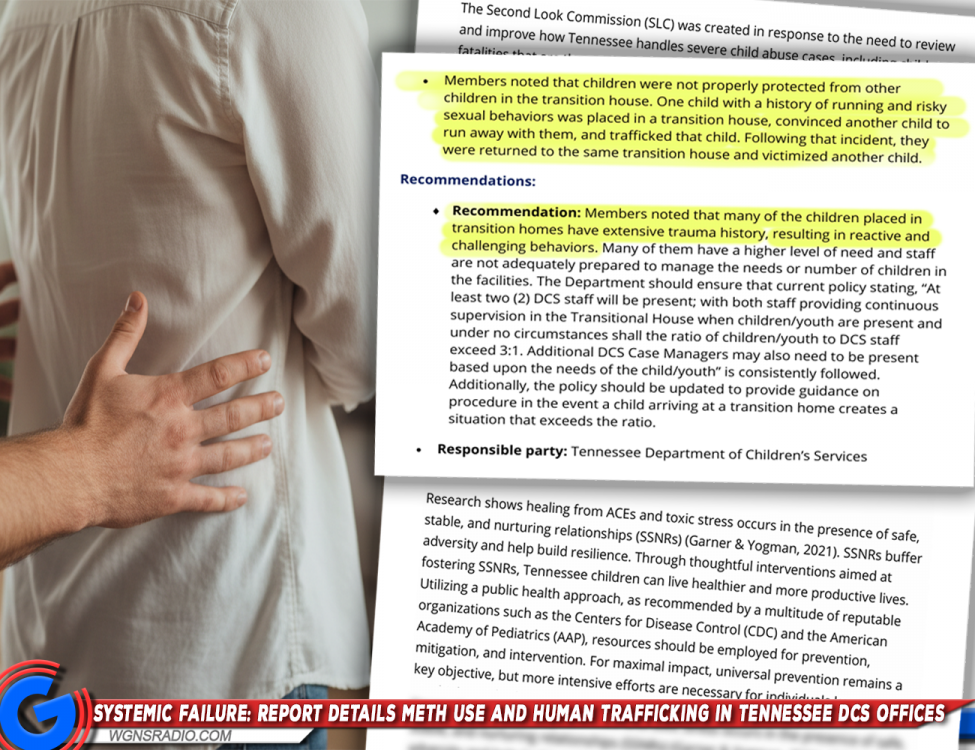
NASHVILLE, TN — A harrowing new report from the Second Look Commission has sent shockwaves through the Tennessee State Legislature, detailing "severe child abuse" occurring within the very facilities meant to protect the state’s most vulnerable youth. The findings reveal that children staying in Department of Children’s Services (DCS) offices and transitional homes have been subjected to drug use and human trafficking due to what advocates call a systemic failure of supervision.

Supervision Crisis in Transitional Spaces - The 17-member commission, tasked with reviewing cases of repeat severe abuse, highlighted a disturbing trend in "Transition Homes and Offices." According to the report, the lack of adequate oversight allowed a child to use methamphetamine while staying inside a DCS office. While the department reportedly confiscated the drugs and administered a drug test, the commission noted a total lack of follow-up investigation to determine if other children in the office had been exposed or had access to the substance.
Even more egregious was a case involving a transition home where an older child, who had a known history of being trafficked, successfully recruited a younger child to run away. The older youth then sex trafficked the younger child.
The incident was described in the “Second Look” report:
“Members noted that children were not properly protected from other children in the transition house. One child with a history of running and risky sexual behaviors was placed in a transition house, convinced another child to run away with them, and trafficked that child. Following that incident, they were returned to the same transition house and victimized another child.”
Despite the severity of the incident, the report found that DCS simply returned the older child to a transition home with other potential victims, creating a higher risk for further recruitment.
A "Worse Than Ever" System - The report comes on the heels of a blistering audit from the Tennessee Comptroller, which found that more than 445 youth spent at least one night in DCS offices in 2025—a 400% increase over the previous year. One child reportedly spent 102 nights sleeping in an office.

Another one of of the many findings in the report highlighted that DCS is allegedly unable to verify the location of some children, with members challenging the documentation of a child's placement:
"Members noted that the Transition House Protocol on documenting where a child is placed was not being followed. The lack of documentation made it nearly impossible to tell where children were each day, when they had run away, and when they returned."
One item within the report stated:
"There were several children documented as being placed at a foster home in Clarksville. However, case documentation and police reporting indicate they were living at a transition home in Davidson."

Repeat Child Abuse Data - The reported number of children who experienced a second or subsequent incident of severe child abuse for FY 2023 is 623, with more than half of those children going through the torment of a second or more incidents of additional “Sexual Abuse.” Those cases impacted 64.%of the children.
The number of children who were subjected to a second or subsequent incident of severe child abuse represents an increase between the fiscal years of 2022 and 2023. The fiscal years listed reflect the disposition date. In many cases, these fall into the same year as the occurrence of abuse, however, sometimes with more complicated cases, such as an abuse death, there is a longer time-frame between the occurrence and the disposition.
Other types of maltreatment that occurred a second time or more with the same child under DCS related care involved 21.8% of the children being exposed to drugs, and another 5.1% experiencing additional physical abuse equaling more psychological harm.
The State’s "Real Estate Plan" - DCS Commissioner Margie Quin appeared before lawmakers earlier this month to defend the department’s progress. She pointed to a $421 million real estate initiative designed to eliminate office stays. The plan includes the construction of:
-
Welcome Places: Six community-based centers for short-term stabilization (up to 16 youth each).
-
Wellness Places: Three regional facilities for 30-day clinical assessments for youth with complex needs.
-
Youth Development Campuses: Modernized, clinically-focused settings for rehabilitation.
While Quin shared design concepts for these "trauma-responsive" spaces, she admitted that ground will not be broken on most facilities until late 2026. This timeline means "hard-to-place" children will likely continue to cycle through transition homes and offices for the foreseeable future.
"You can't expect kids to stay in offices and not have terrible things happen," said Marcia Lowry, Executive Director of A Better Childhood. "There's just no supervision for these kids. They are being destroyed by these circumstances."
Lowry, whose organization has filed a federal class-action lawsuit against the department, argues that Tennessee’s foster care system has deteriorated significantly since federal court monitoring ended in 2017. The lawsuit alleges that DCS "warehouses" children in spaces lacking basic necessities like bedding and soap, and frequently moves them between unstable placements.
Unreported Runaways - The Second Look Commission also uncovered a breakdown in documentation. In one instance, a child ran away from a transition home eight times, but DCS staff only filed two official reports. Commissioner Quin has pledged that the department will "do a better job monitoring" these facilities, but for advocates like Lowry, the promises come too late for the children currently at risk.
Again, to address immediate needs, DCS is hiring nine behavior specialists and has opened additional cottages on the Cloverbottom campus in Nashville to provide more beds for youth awaiting placement.
- See the "Second Look Commission" Report HERE (PDF)