
MURFREESBORO, Tenn. — Businesses within the city limits that have sufficient land and meet the required criteria will be allowed to fly much larger flags in front of their buildings as soon as this Friday. This news in after the Murfreesboro City Council amended the sign ordinance to allow for larger flag placement in certain areas of the community... With the adjustment to the sign ordinance, properly zoned organizations could receive the green light to construct a massive new flag on their property, under Ordinance 26-O-06. This recent change took place earlier this month with council members casting their vote of approval to amend the city’s previous sign regulations to allow for large, permanent ground-mounted flag - signs in select zoning districts...
With the change, businesses can now fly larger flags on their property, assuming the business or organization is able to meet the requirements to do so. According to the new regulations, flags can be as large as 4,000 square feet in size The measure modifies Chapter 25.2 of the Murfreesboro City Code, specifically Section 25.2-26 governing on-site permanent sign requirements (See the new changes HERE).
The amendment was recommended for approval by the Planning Commission on January 7, 2026, following a public hearing, and was approved by the City Council on first reading February 5 before receiving final passage earlier this month.
Where Large Flag Signs Are Permitted - Under the newly adopted ordinance, permanent ground-mounted large flag signs are permitted in H-I (Heavy Industrial), L-I (Light Industrial), and P (Park) zoning districts, but only on lots of 20 acres or more.
The ordinance limits each qualifying property to one large flag sign per lot. Notably, the large flag sign does not count toward the total number of wall or ground-mounted flag signs otherwise permitted under existing regulations.

Size, Height and Setback Requirements - The newly adopted amendment outlines strict size, height and setback standards for large, permanent ground-mounted flag signs. Under the ordinance, a flag may be no larger than 4,000 square feet, with its length capped at 80 feet. The width of the flag cannot exceed one-third of the total height of the flagpole. In addition, the flagpole itself is limited to a maximum height of 150 feet.
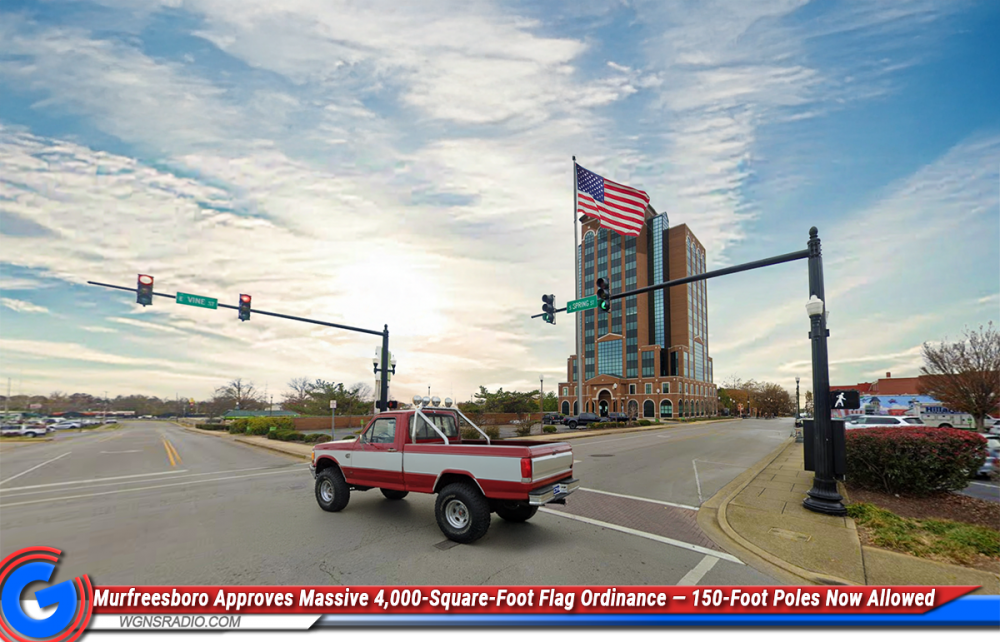
Real-World Illustration of Size — To ensure safety and compatibility with surrounding properties, the ordinance also requires a minimum setback of 200 feet from all property boundaries and any above-ground utility lines. The designated fall zone — the area where the structure could potentially collapse — must remain entirely within the property’s boundaries. Furthermore, neither the flag, flagpole, nor any supporting structure may extend over a public right-of-way or onto neighboring property. Lighting is also regulated, with illumination restricted to indirect lighting only, and any glare directed onto adjacent properties is strictly prohibited (See the illustration above this article to get a better idea of how large a 4,000 square foot flag would be).
To better illustrate just how large a flag could be under the new ordinance, there is essentially only one workable configuration if an operator wants to fly the maximum 4,000-square-foot flag allowed. First, the property must be at least 20 acres in size and located within one of the qualifying zoning districts. Second, a 150-foot flagpole — the maximum height permitted — would need to be installed in order to accommodate a flag measuring 50 feet tall by 80 feet long.
15-Story Flagpole — A 150-foot pole is roughly the height of the only 15-story building in downtown Murfreesboro, the NHC building. The flagpole would need to be engineered to handle substantial wind loads. A flag measuring 50 feet by 80 feet would span approximately five stories in height and stretch nearly the length of five 1980s Ford F-150 pickup trucks parked end-to-end. The scale of such a display would require heavy-duty construction and careful site placement to comply with setback and fall-zone requirements.
However, such a large installation would not be feasible in the downtown area due to zoning restrictions and parcel size limitations under the newly amended ordinance. The comparison above helps illustrate the magnitude of a 4,000-square-foot flag, as well as the significant space and structural considerations required to lawfully fly one under the new regulations.
Purpose and Economic Development Impact - City officials stated the amendment is intended to balance public safety and visual regulation with economic development objectives. According to the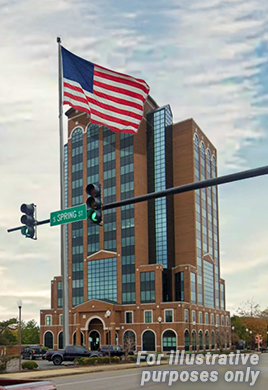 council communication, the measure supports efforts to “Establish Strong City Brand” and “Improve Economic Development” by allowing an additional signage option for businesses in qualifying districts.

By restricting the signage to large industrial and park-designated parcels, the ordinance limits the visual and structural impact to areas where substantial land buffers already exist.
Effective Date - The ordinance takes effect 15 days after passage on second and final reading, in accordance with its adoption clause. Accordingly, those who operate a business can begin flying the flag of their choice as soon as this Friday (February 27, 2026).
City officials emphasized that the amendment reinforces Murfreesboro’s regulatory framework by clearly defining dimensional standards, setback requirements, and operational constraints for large flag installations, ensuring both economic flexibility and public safety compliance.
Photos: The photo above this article and the photo within this article are for illustrative purposes only — to show how tall a 150-foot flagpole would be and to demonstrate the size of a 4,000-square-foot flag. The images were created or modified by WGNS solely as examples to illustrate the scale of such a massive flag and flagpole in comparison to the tallest commercial building in Murfreesboro, TN.