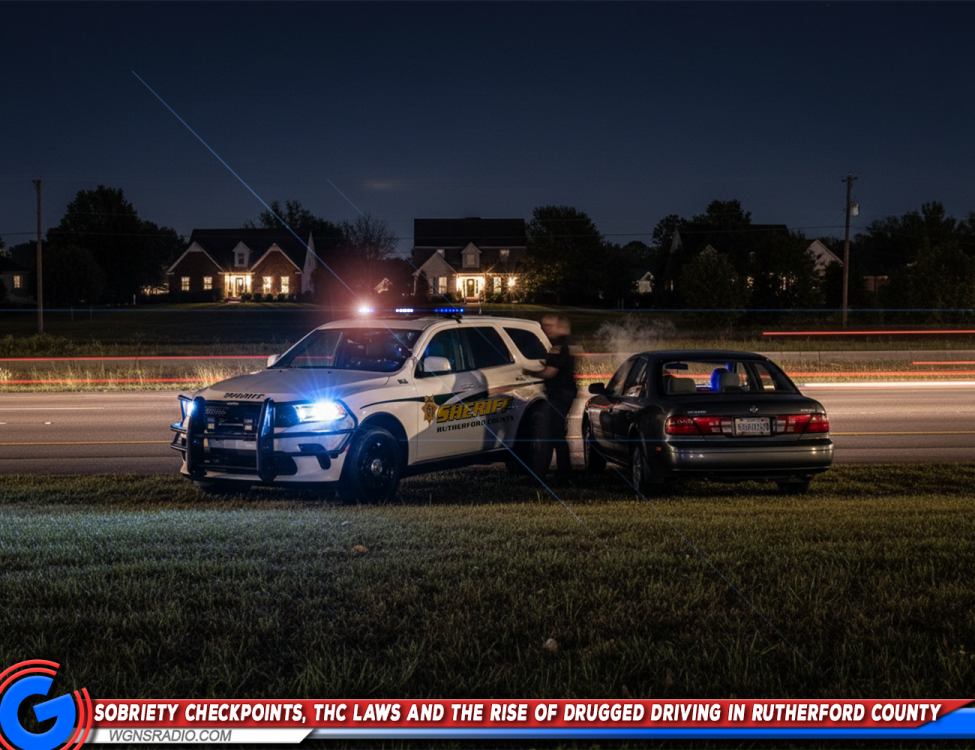
RUTHERFORD COUNTY, TN (WGNS) - According to data from the Tennessee Department of Safety and Homeland Security, thousands of impaired driving arrests are made across the state each year, reflecting a persistent challenge for local law enforcement. While alcohol remains a primary concern, the rise in marijuana use and its impact on road safety has become an increasingly significant focus for agencies like the Rutherford County Sheriff’s Office. Sergeant Austin Watson, a supervisor over the traffic unit at the Rutherford County Sheriff’s Office, noted that while alcohol-related DUIs remain more prevalent due to alcohol’s legal status, drug-impaired driving is growing as marijuana becomes more accessible and legalized in various forms across the country.

One of the dual-purpose tools used in DUI enforcement is the sobriety checkpoint... Sgt. Watson said checkpoints serve as both an educational and visual deterrent, while also functioning as an enforcement mechanism to remove impaired drivers from the roadway. The most recent local checkpoint was conducted on Barfield-Crescent Road near Murfreesboro, Feb. 13, 2026.
WGNS asked Watson whether drivers are allowed to make a U-turn to avoid a checkpoint... We then asked whether deputies can send a patrol car after drivers who make an obvious attempt to avoid going through the checkpoint...
As far as what time of day or night most DUI drivers are on the road, Sgt. Watson stated... Societal behavior indicates that more drivers tend to be out later in the week and on weekends due to sporting events, extended time off work, parties, dinners with friends, and other social gatherings — all of which increase the potential for a higher number of impaired drivers on the road.
The conversation then turned to marijuana and driving, which is a growing concern as products containing THC become more readily available... Sgt. Watson explained that marijuana can have impairing effects on a driver’s ability similar to alcohol, although it lacks certain indicators such as nystagmus — the involuntary jerking of the eyes often checked during traffic stops... Horizontal Gaze Nystagmus (HGN) becomes more pronounced with alcohol impairment and is observed when there is a lack of smooth eye movement, resulting in a distinct jerking at maximum deviation. While marijuana use does not typically produce the HGN effect, the core issue remains the same as with alcohol... The bottom line is that the introduction of any substance that alters a driver’s mental or physical faculties can result in a DUI charge.
As the number of individuals who, for example, stop at a gas station to purchase a beer, open it while driving, and actively consume it on the highway has decreased... The number of individuals who smoke a THC-containing product while actively driving has risen. But...
New Tennessee legislation signed into law last year will take full effect in just four months... While most of the new regulations took effect on January 1, 2026, an agreement between the state and industry groups delayed full enforcement of certain restrictions until July 1, 2026.
Under the updated law, products containing Tetrahydrocannabinolic acid (THCa) and other hemp-derived cannabinoids with a concentration exceeding 0.3% on a dry-weight basis will be banned — effectively eliminating most smokeable hemp flower and high-potency vape products. Retailers, convenience stores, and grocery outlets operating under “legacy licenses” issued by the Department of Agriculture prior to January 1, 2026, may continue selling their existing inventory until those licenses expire on June 30, 2026. After that date, businesses must either comply with stricter, lower-THC standards or cease sales altogether. Additionally, sales of hemp-derived cannabinoid products will be restricted to in-person transactions for individuals age 21 and older. Bars and restaurants with proper licensing may sell such products for on-premises consumption, but “to-go” sales will not be permitted.

Read More Details Posted by the Tennessee Highway Safety Office HERE.
Tetrahydrocannabinol, commonly known as THC, is the compound that interacts with the body’s endocannabinoid system (ECS) to produce psychoactive effects, including euphoria, relaxation, and altered sensory perception. The ECS, discovered in the 1990s, is a complex cell-signaling network that helps maintain homeostasis — or balance — by regulating mood, sleep, pain, appetite, and immune response through CB1 and CB2 receptors and neurotransmitters that interact with cannabinoids.
Watson emphasized that state law defines a DUI based on whether a substance mentally or physically impairs a driver, regardless of the substance involved. “It is still an impairing substance; it just depends on how it’s impairing you at the time of the stop,” Sgt. Watson stated.
Sergeant Watson also noted that some drivers mistakenly believe that because certain THC-containing products are legal to purchase, they are safe to use while operating a vehicle. That belief is false.
National studies, including research by the National Highway Traffic Safety Administration (NHTSA), indicate that marijuana can slow reaction time, impair judgment, and decrease coordination — all critical skills for safe driving. While some users claim they can drive safely while under the influence, the data suggests otherwise. A major challenge for law enforcement is the absence of a standardized “breathalyzer” for marijuana, making the observations of trained officers and field sobriety testing even more critical. Sgt. Watson said his team remains especially vigilant during late-night weekend hours when impaired driving is most common, though he emphasized that impaired drivers can be on the road at any time. “I believe that impaired drivers are on the road 24/7,” Watson said.