
RUTHERFORD COUNTY, Tenn. (WGNS News) - Aggravated Sexual Exploitation of a Minor is one of the charges a longtime Rutherford County real estate agent is scheduled to face when he appears TODAY (9 AM - Wednesday, July 1, 2026), in the courtroom of Circuit Court Judge Barry Tidwell. In this proceeding, the defendant appears to be on the brink of entering a plea in a criminal case centered on allegations of not only Aggravated Sexual Exploitation of a Minor, but also unlawful photography and related offenses, according to court documents.

More than one year ago, at the request of 16th Judicial District Attorney General Jennings Jones, special agents with the Tennessee Bureau of Investigation launched an investigation on May 1, 2025, into allegations involving 46-year-old Justin Holder of Murfreesboro. Following the execution of search warrants, evidence collection, and interviews conducted by investigators, a Rutherford County Grand Jury returned indictments against Holder on March 4, 2026.
Holder was charged with one count of Aggravated Sexual Exploitation of a Minor, two counts of Disseminating Unlawful Photographs, two counts of Unlawful Exposure with Intent to Cause Emotional Distress, and four counts of Unlawful Photographing in Violation of Privacy. The case remains open, and the charges are allegations at this stage of the judicial process.
Cases involving allegations of unlawful photography often move through the court system with far more legal complexity than what may appear in the initial snapshot of the charges themselves. In this case, investigators are believed to have focused much of their attention on photos or video recordings allegedly obtained without the knowledge or consent of the individuals that were captured in the recordings. The TBI seized those files as evidence. Scroll down to continue reading this article and for larger images / photographs.
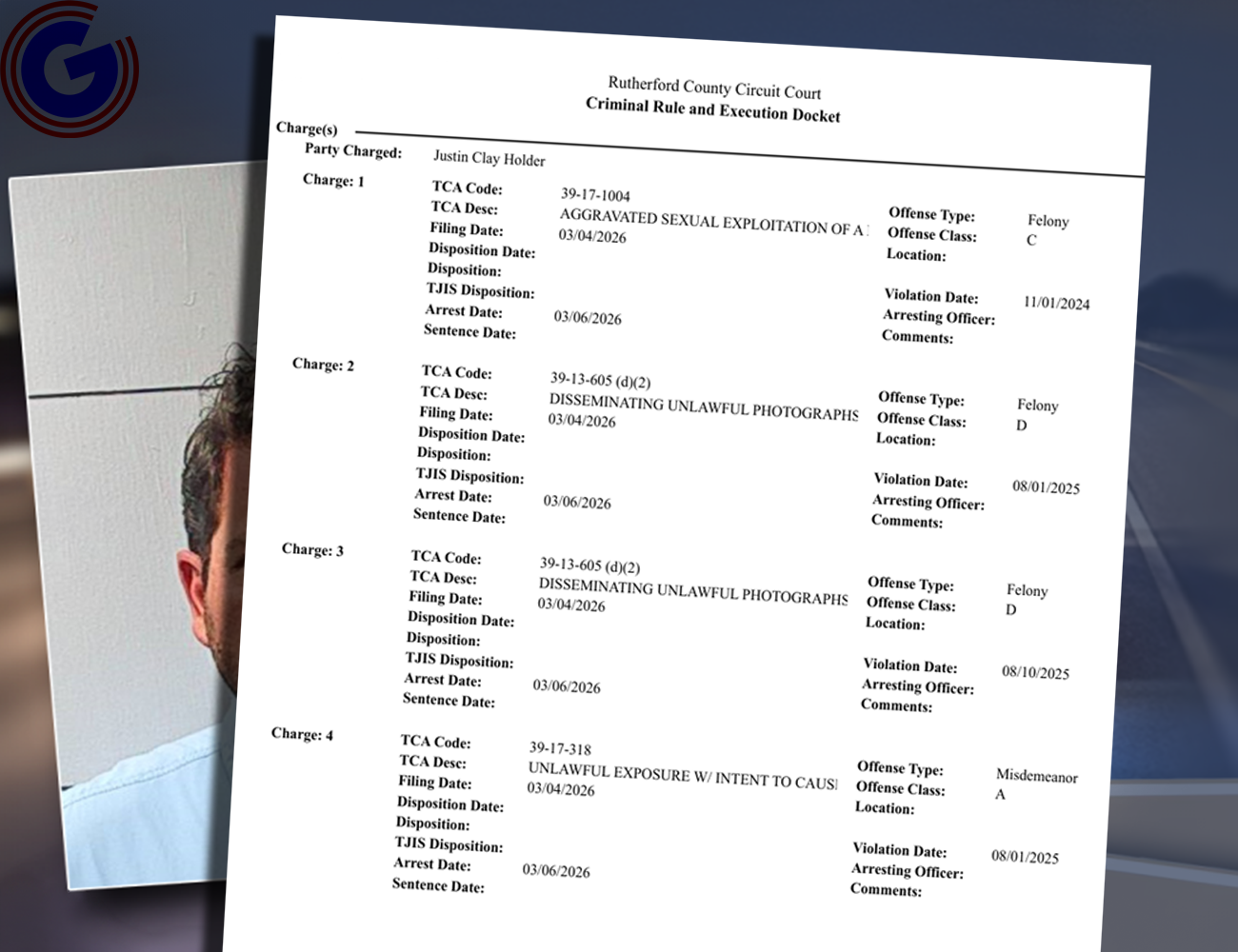
Legal observers may note that when the alleged evidence itself, such as photography related files, becomes the focal point of the prosecution, the judicial process can quickly shift into a difficult balancing act involving privacy rights, constitutional protections, discovery access, and evidentiary admissibility.
While the public may view photographs or recordings as straightforward pieces of evidence, attorneys and judges often examine the finer exposure settings surrounding how the material was allegedly created, stored, seized, and ultimately introduced into court.
In Tennessee felony and misdemeanor proceedings, a plea hearing can often indicate the case is moving toward resolution without the need for a full jury trial. During those hearings, judges commonly review negotiated agreements, question defendants under oath, explain constitutional rights being waived, and determine whether a proposed plea should be accepted.

However, cases involving hidden-camera allegations, unlawful recordings, juveniles, or subjects allegedly filmed without consent can require courts to take a slower shutter approach before fully resolving the matter.
One of the most legally sensitive areas involves discovery - the process in which prosecutors provide evidence to defense attorneys. Tennessee courts generally recognize that defense counsel must be allowed to review evidence the State intends to use against a defendant. That can include phones, digital storage devices, hard drives, forensic extractions, photos, and video files.
But when the material allegedly involves intimate recordings, minors, or individuals protected under Orders of Protection, courts may sharply narrow the aperture of who can actually view the evidence and under what conditions.
In some Tennessee courtrooms, judges have ordered that only defense counsel - not the defendant personally - may review certain files. In other cases, attorneys are required to inspect the material only within a forensic lab or prosecutor’s office. Additional restrictions can prohibit reproduction, distribution, screenshots, cloud uploads, or electronic duplication of the material altogether.
The legal focus then widens beyond discovery into a separate, but related issue: admissibility.
Even if evidence is made available to defense counsel for review, judges must still determine whether the photos or videos themselves can legally be shown at trial. That process can involve constitutional arguments, motions to suppress evidence, evidentiary hearings, privacy considerations, forensic authentication disputes, and questions surrounding whether recordings were unlawfully obtained to begin with.

Cases involving juveniles often add another layer of judicial caution. Tennessee law strongly protects the identity and privacy of minors, particularly in matters involving allegations of sexual exploitation. Courts must then balance a defendant’s Sixth Amendment right to prepare a defense against the risk of further harm or re-victimization to alleged victims.
Orders of Protection can also become part of the legal framework surrounding cases involving alleged unlawful recordings. Judges may consider whether possession, dissemination, or handling of the material violates existing court orders designed to prevent harassment, intimidation, or additional emotional distress.
As a result, the same photos or videos at the center of a criminal case may ultimately become discoverable to defense counsel while still potentially being ruled inadmissible before a jury ever sees them.
Legal analysts say pre-arranged plea agreements can sometimes bring those legal battles into sharper focus while simultaneously allowing alleged victims - many of whom never expected to become publicly exposed - to move further out of the spotlight as the court process narrows toward resolution.
If a negotiated plea agreement has been reached in Holder’s case, Judge Tidwell will ultimately determine whether to approve, reject, or modify the agreement. Depending on the outcome, sentencing could occur immediately or at a later date. Potential outcomes in felony plea agreements can range from prison sentences to suspended sentences involving probationary supervision and strict court-imposed conditions.
Further details surrounding the outcome of Wednesday’s hearing may not become publicly available until all court filings and judicial approvals are finalized.
In the local real estate landscape where Holder has worked for more than 20 years, state records indicate his real estate license is currently inactive.
According to the Tennessee Department of Commerce and Insurance, Holder’s real estate license was effectively retired as of March 12, 2026. His original license was approved approximately 21 years ago.
WGNS will continue following developments in the case as they move through the Rutherford County court system.

DISCLAIMER: All suspects are presumed innocent until proven guilty in a court of law. The arrest records or information about an arrest that are published or reported on NewsRadio WGNS and www.WGNSradio.com are not an indication of guilt or evidence that an actual crime has been committed.
Previous News Article: RUTHERFORD COUNTY, TN - At the request of 16th Judicial District Attorney General Jennings Jones, special agents with the Tennessee Bureau of Investigation launched an investigation on May 1, 2025, into allegations involving Justin Holder, 46, of Murfreesboro. Following the collection of evidence and interviews conducted by investigators, the Rutherford County Grand Jury returned indictments on Wednesday (March 4, 2026), charging Holder with multiple offenses. The suspect was apprehended two days after the indictments were returned. The charges include one count of Aggravated Sexual Exploitation of a Minor, two counts of Disseminating Unlawful Photographs, two counts of Unlawful Exposure with Intent to Cause Emotional Distress, and four counts of Unlawful Photographing in Violation of Privacy.
A little over one month after the investigation began, the Deputy Communications Director of the TBI confirmed with WGNS that agents had executed a search warrant at the 5,200-square-foot home belonging to Holder on Oakleigh Drive in Murfreesboro. The TBI stated the warrant was "...in connection to an ongoing investigation." Court records from a separate incident indicate the TBI reportedly visited Holder's home regarding alleged possession of child pornography and other unlawful nude images and recordings of adult third parties, which were allegedly disseminated to a female acquaintance via Facebook Messenger.
On the same date TBI agents visited Holder's home, Holder had contact with a law enforcement officer and was accused of driving under the influence. A criminal warrant was issued, and an arrest by Murfreesboro Police followed several days later, with Holder being charged with “DUI: First Offense” on June 11, 2025. A hearing for that case is set for April 27, 2026.
Twenty-four days after the warrant was served by the TBI at Holder's home, the property was sold for around $1.5 million before it was publicly listed. Holder was reportedly one of the last agents to sell the home and the last buyer's agent working to sell the home in the past three years. He currently has a real estate license that was activated in October 2025 through a real estate agency with an office based in Atlanta, Georgia. Holder's license was activated with the company in October 2025, but his first license to sell real estate in Tennessee was activated 21 years ago in 2005, according to the Tennessee Department of Commerce and Insurance, which shows that his license is currently active and expires in August 2027.
This past week, Holder surrendered to authorities at the Rutherford County Jail on Friday afternoon. He was booked into the Rutherford County Adult Detention Center at 2:40 PM on March 6, 2026, and was released about two hours later after posting a $75,000 bond.
Of the charges that the suspect faces, Aggravated Sexual Exploitation of a Minor is the most serious and is classified as a Class B felony. The law states that the state does not have to prove the exact identity or age of the minor depicted in order to bring charges, which carries severe penalties under state law.
Under Tennessee law, a person charged with Aggravated Sexual Exploitation of a Minor is accused of being involved in the creation, production, or facilitation of sexually explicit material involving a minor. Specifically, the statute makes it illegal for someone to knowingly promote, employ, use, assist, transport, or allow a minor to participate in the production or performance of sexually explicit material, including situations where the minor is depicted engaging in sexual activity or simulated sexual activity that would be considered patently offensive. Holder was charged with one count of Aggravated Sexual Exploitation of a Minor.
Tennessee law shows that a person can be charged with Disseminating Unlawful Photographs if they are accused of intentionally sharing or distributing images of another person in a way that violates that person’s privacy. In most cases, the allegation involves someone knowingly distributing photographs or videos that show another person’s intimate parts or nudity without that person’s consent, particularly when the images were originally created or obtained under circumstances where the person expected them to remain private. The suspect faces two counts of Disseminating Unlawful Photography.
The charge of unlawful exposure occurs when a person distributes private, intimate images of another with the intent to cause emotional distress, or distributes AI-generated or modified images of someone, which is a Class A misdemeanor. Holder faces two counts of Unlawful Exposure with Intent to Cause Emotional Distress.
Holder also faces four counts of Unlawful Photographing in Violation of Privacy, a Class A misdemeanor. The law in Tennessee says this occurs when someone knowingly photographs or records an individual without consent in a private setting where a reasonable expectation of privacy exists.
Several years prior to Holder being indicted, and according to reports filed with the Rutherford County Sheriff's Office, deputies responded to complaints from a woman who reported receiving repeated unwanted text messages and phone communications from someone she believed to be Holder. The messages allegedly began around 2018 and continued intermittently into 2020 and 2021. The victim told investigators that the messages referenced a medical procedure she had undergone and asked for photos related to that procedure. Some of the messages appeared to come from web-based or masked phone numbers, and the sender allegedly posed as someone connected to a medical office or practice in order to ask questions about the procedure and request images. The victim stated she believed the sender was Justin Holder, a coworker, and that similar unwanted messages had also been sent to another woman in the same workplace.
Investigators documented multiple interviews and case notes related to the complaint. Officers collected screenshots of the text conversations and attempted to trace the phone numbers used to send the messages. Subpoenas and search warrants were issued to telecommunications and technology companies in an effort to identify the account holder and associated IP addresses connected to the messaging accounts.
Although records showed that Google services and certain IP addresses were linked to accounts bearing Justin Holder’s name, one being “Justin@JustinHolder.com,” and IP addresses corresponding to the dates and times that the offending text messages were sent, investigators ultimately reported that key records had been purged due to retention limits, preventing them from conclusively proving that Holder sent the messages at the specific times they were transmitted. As a result, the case notes indicate prosecutors were advised that the available evidence would likely be insufficient to pursue charges in that particular investigation.
Case notes showed the detective followed up with one of the alleged victims in June of 2021 to find out if the woman was interested in pursuing charges; however, phone calls from the detective went unanswered. The detective wrote in his case notes that several weeks prior to calling the female, she told the detective that she wasn't sure if she wanted to pursue the case. The same detective noted that his request for an outline of Holder's transgressions was met with the answer of, “...she would think about it and get back with me.” According to the notes, the detective did not hear back from the woman, so he left her a voicemail stating, “I would take no further action absent her request.”
The last note filed in the detective's case was on March 22, 2022, and stated, “As of this date, I've obtained no further evidence tying suspect Justin Holder to the text messages sent,” and that the statute of limitations expired on January 22, 2022, highlighting the closure of the case.
- Original News Article can be found HERE.
DISCLAIMER: All suspects are presumed innocent until proven guilty in a court of law. The arrest records or information about an arrest that are published or reported on NewsRadio WGNS and www.WGNSradio.com are not an indication of guilt or evidence that an actual crime has been committed.
Sources:
Tennessee Bureau of Investigation
2021 Case Number: 21031802358
Tennessee Department of Commerce and Insurance
Rutherford County Courts