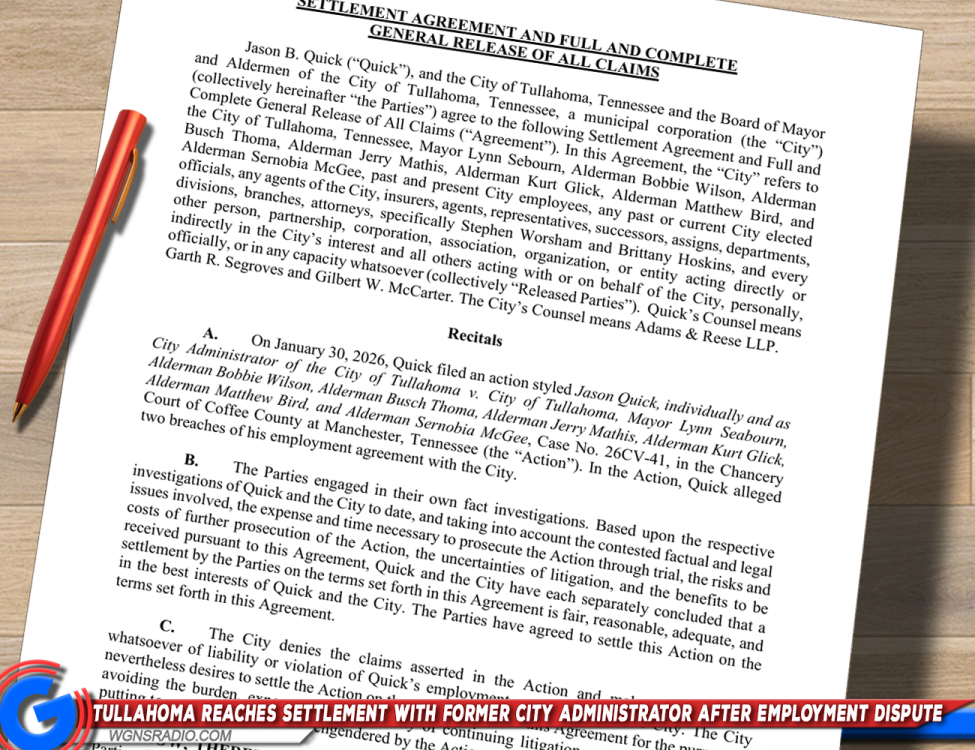
TULLAHOMA, Tenn. — A legal dispute between former Tullahoma City Administrator Jason B. Quick and the City of Tullahoma has been resolved through a settlement agreement that ends a lawsuit filed earlier this year in Coffee County.

According to settlement documents, Quick filed a lawsuit on January 30, 2026, in the Coffee County Chancery Court in Manchester, alleging that the city had breached his employment agreement. The case, titled Jason Quick, individually and as City Administrator of the City of Tullahoma v. City of Tullahoma, et al., named the city and several members of its governing board as defendants.
The defendants included Mayor Lynn Sebourn and members of the Tullahoma Board of Mayor and Aldermen, including Bobbie Wilson, Busch Thoma, Jerry Mathis, Kurt Glick, Matthew Bird, and Sernobia McGee.
After conducting separate investigations and weighing the costs and uncertainties of continued litigation, both sides agreed to settle the dispute. The settlement agreement states that the decision was reached to avoid the burden, expense, and uncertainty associated with further legal proceedings.
Under the terms of the agreement, the City of Tullahoma will pay a maximum total settlement amount of $55,923.36. The payment includes severance compensation, litigation-related costs, and other expenses connected to the resolution of the lawsuit.
Of that amount, $51,923.36 will be paid to Quick as four months of severance, distributed through bi-weekly payments consistent with the city’s payroll practices. An additional $4,000 payment will be issued as a lump sum that Quick may apply toward potential COBRA health insurance coverage, according to the settlement agreement.
The agreement also states that Quick immediately and irrevocably resigned from his position as city administrator effective February 26, 2026, ending his employment relationship with the city. His employment agreement with the city, originally signed in January 2024, was terminated as part of the settlement.
As part of the settlement, both sides agreed to dismiss the lawsuit with prejudice, meaning the claims cannot be refiled in court. Each party is responsible for its own legal costs unless otherwise specified in the agreement.

The agreement also includes a mutual release of claims, meaning Quick and the city agreed to release each other from any claims related to his employment up to the date of the settlement. The document outlines that the release covers a broad range of potential legal claims under federal and state law, including employment-related statutes and contract disputes.
Additionally, the agreement contains provisions addressing confidentiality, non-disparagement, and cooperation in potential future litigation involving city matters that occurred during Quick’s tenure as administrator.
The document notes that the settlement does not constitute an admission of wrongdoing by either party, and the city specifically denied the allegations raised in the lawsuit while agreeing to resolve the dispute to avoid continued litigation.
Both parties signed the settlement voluntarily after negotiations through their respective legal counsel, bringing the dispute to a close.