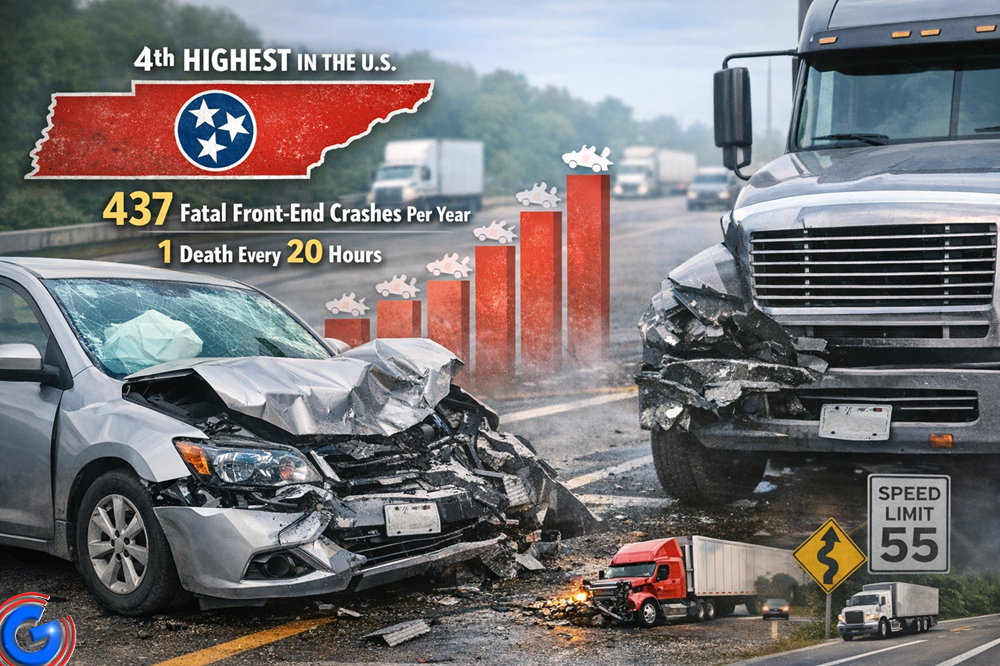
TENNESSEE (WGNS) - The Volunteer State sits in the middle of a troubling national hotspot for fatal front‑end crashes, and new federal data shows just how serious the problem has become. Between 2019 and 2023, the state averaged 5.98 fatal front‑end collisions per 100,000 residents — the fourth‑highest rate in the country. That works out to roughly one Tennessean lost every 20 hours, or about 437 people each year.

The pattern doesn’t stop at the state line. Six of Tennessee’s seven neighboring states also rank in the national top 11 for deadly front‑end crashes. And among the top 10 states overall, seven share a border with Tennessee. That clustering makes the Volunteer State the center of the most dangerous region in America for this type of collision.
Experts say several factors are driving the trend. Tennessee has a large and growing mix of commercial traffic, and heavy trucks tend to make front‑end crashes more severe. Roadway design plays a role too. Neighboring Georgia, for example, has far more vehicles — including a massive freight presence — but many of its interstates are six to ten lanes wide, offering more separation and straighter geometry than Tennessee’s narrower, more congested corridors.
Front‑end crashes are especially deadly because the force of the impact hits the vehicle’s strongest structure head‑on. Smaller cars striking SUVs or trucks face an added disadvantage due to mismatched bumper heights. And driver behavior continues to show up in crash reports statewide, with speeding, distraction, and impairment among the most common contributors.
But Tennessee isn’t powerless. Safety researchers point to several steps that could make an immediate difference. Lower speed limits in high‑risk corridors, more medians and roundabouts, and better nighttime lighting all reduce the severity of head‑on and front‑to‑rear impacts. Stronger enforcement of distracted‑driving and impaired‑driving laws would help too.
The biggest gains, though, may come from the vehicles themselves. Automatic emergency braking, forward‑collision warnings, lane‑keeping systems, and improved crash‑compatibility engineering are already reducing front‑end crashes nationwide. Future vehicles will go even further, with adaptive front structures, smarter sensors, and vehicle‑to‑vehicle communication designed to prevent collisions altogether.
For now, Tennessee remains in a dangerous neighborhood. But with better roads, better behavior, and rapidly improving technology, the state has a real chance to turn the numbers around.