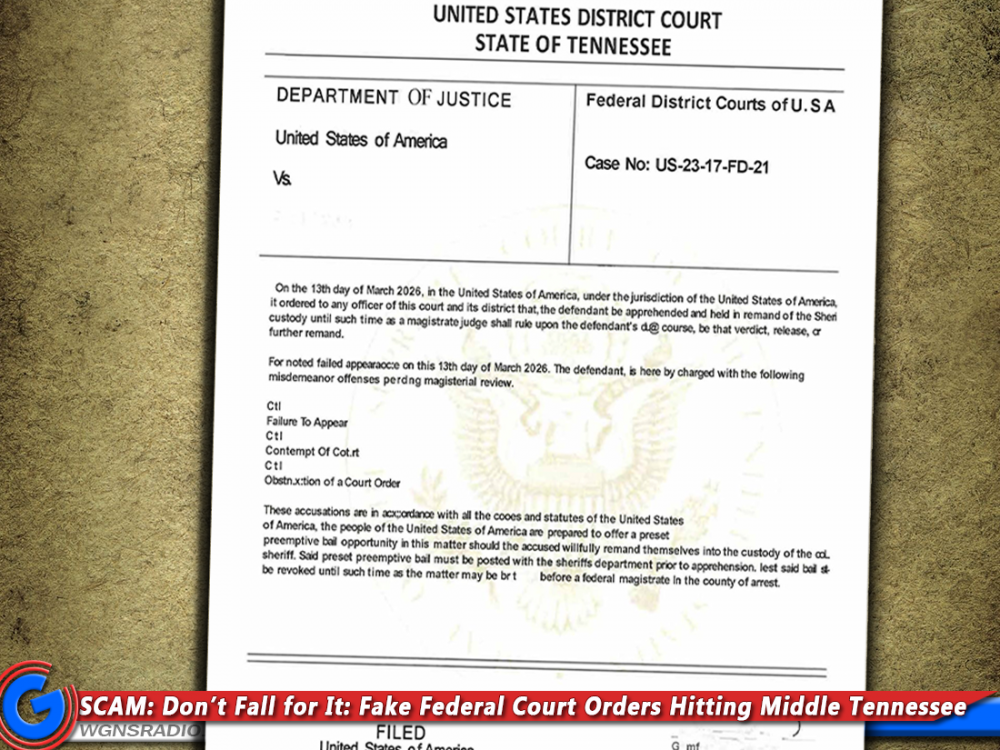
FRANKLIN, TN — The Williamson County Sheriff’s Office (WCSO) is warning residents across Middle Tennessee about a sophisticated email scam involving fraudulent documents posing as official federal court orders. Authorities say scammers are sending emails with attachments that appear to come from a “United States District Court State of Tennessee,” falsely claiming the recipient has failed to appear in court and now faces arrest.

The document—designed to mimic an official federal filing—alleges misdemeanor charges such as “Failure to Appear,” “Contempt of Court,” and “Obstruction of a Court Order.” It further claims a warrant has been issued and instructs the recipient to pay a so-called “preset preemptive bail” to avoid being taken into custody.
Anatomy of the Fraudulent Document - At first glance, the document attempts to project legitimacy. It features references to the Department of Justice, a case number, and what appears to be a federal court heading. However, a closer inspection reveals numerous inconsistencies that expose it as fraudulent.
The header incorrectly blends jurisdictions, stating “United States District Court” alongside “State of Tennessee”—two separate legal systems that would never be combined in an official filing. Authentic federal court documents clearly identify the correct district (such as Middle District of Tennessee) and do not merge federal and state authority.
The body of the document contains multiple typographical errors and nonsensical phrasing, including words like “appearaoc:e,” “perdng,” and “cooes,” as well as symbols such as “d@course.” These errors are highly uncharacteristic of legitimate court filings, which undergo strict formatting and proofreading standards.
Additionally, the language used is legally inaccurate. Phrases such as “preemptive bail opportunity” and instructions for a defendant to “willfully remand themselves” are not recognized legal procedures. Courts do not offer advance payment options via email to avoid arrest.
Visually, the document also raises concerns. The seal appears faint and improperly layered, while signatures and formatting elements look distorted and inconsistent—common indicators of digitally manipulated or mass-produced scam materials.
High-Pressure Tactics - Officials say the scam relies heavily on urgency and fear. By threatening immediate arrest and legal consequences, scammers aim to pressure victims into acting quickly—often without verifying the legitimacy of the document.

“The goal is to create panic,” authorities said. “When someone believes they’re facing arrest, they’re more likely to comply without questioning the details.”
The demand for payment—framed as a way to avoid jail—is a major red flag. Law enforcement agencies and courts do not request bail, fines, or fees through unsolicited emails or digital payment methods.
What Residents Should Do - The Williamson County Sheriff’s Office urges anyone who receives a similar email to take the following precautions:
- Do not respond to the email or open suspicious attachments if unsure of the source
- Do not send money or provide personal information under any circumstances
- Verify independently by contacting your local court clerk or sheriff’s office using official phone numbers
- Report the incident to local law enforcement
Officials emphasize that legitimate court actions—such as warrants or summons—are served in person by law enforcement or delivered through certified U.S. Mail, not through unsolicited email attachments.
A Growing Trend - This type of scam reflects a broader trend of increasingly sophisticated phishing attempts that mimic government documents. By leveraging official-sounding language and formatting, scammers are becoming more convincing—but small details often give them away.
Residents are encouraged to remain vigilant and share this information with friends and family, particularly those who may be more vulnerable to high-pressure fraud schemes.

Bottom line: If a document demands immediate payment to avoid arrest, contains obvious errors, or arrives unexpectedly by email—it is almost certainly a scam.