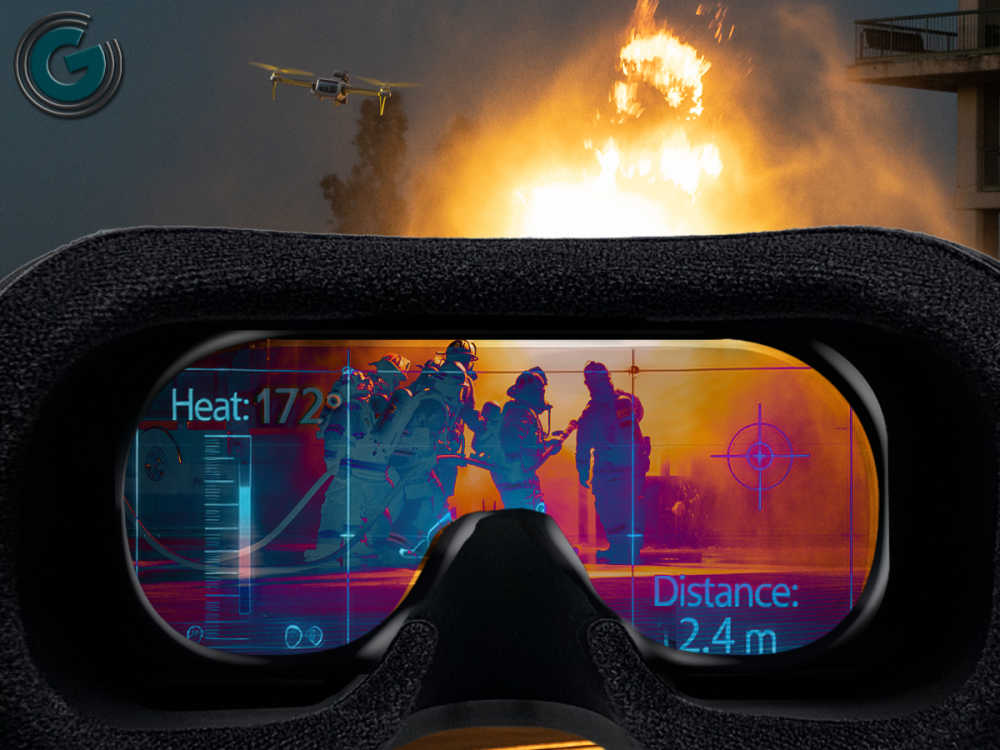
MURFREESBORO, TN (WGNS News) - Nearly 40-years ago, Murfreesboro Fire and Rescue became the first department in Rutherford County to invest in "advanced" thermal imaging systems, or at least, what passed for advanced at the time... That was Murfreesboro Fire and Rescue Chief Mark McCluskey. He recalls that back then, the cost of entry for this technology was incredibly high, with a single helmet-mounted unit costing $25,000...

As you might imagine, the black-and-white picture quality on those early thermal cameras was quite limited compared to today’s standards... In the years since, the leap in firefighting equipment has been astonishing.
Much like the falling price of a big-screen TV, the cost of thermal imaging has plummeted even as the technology has become ten to one hundred times more effective... Today’s Thermal Imaging Cameras - or "T-I-Cs" - provide clarity that allows firefighters to instantly identify people through thick smoke and heat... New units can now be purchased for as little as $500, though high-end models can still reach the $10,000 to $15,000 range. However, the majority of high end thermal cameras on the market are still more than half the cost of the original versions that were introduced in the late 1980's and early 1990's.
The classic image of a firefighter with only an axe and a hose is rapidly becoming a relic of the past as first responders across Middle Tennessee embrace a digital change. That shift was evident last month when Chief McCluskey and other department leaders traveled to Indianapolis for the Fire Instructors Conference International - the largest firefighting convention in the world. The Chief noted that a central theme this year was the integration of Artificial Intelligence...
While the "front line" of the past relied on grit alone, today’s front line is defined by computers, AI-aided devices, and virtual reality training. While water and ladders remain essential, so are the high-tech tools used to tackle blazes and rescue victims.
Local agencies are also increasingly turning to drones to provide a 360-degree view of a fire, including roof temperatures that aren't visible from the ground... Chief McCluskey stressed that drones are now invaluable assets for search-and-rescue and hazmat calls. By using specialized sensors, drones can detect dangerous chemicals, temperatures and the location of potential victims by their body heat, without ever putting personnel at risk.
BELOW: Scroll down to see a real-life thermal image captured by a drone during MFRD training in Murfreesboro.


Bottom Line: This growing trend in emergency service work includes a balanced streamlining of tasks through technology, all in an effort to provide a larger safety net for crews, while giving first responders more time to focus on what they do best - - saving lives.
LISTEN: To hear more about the rapid change in technology, the new tools of today's firefighter and more, listen to our most recent podcast. Hear what MFRD Chief Mark McCluskey told WGNS News by Clicking HERE.