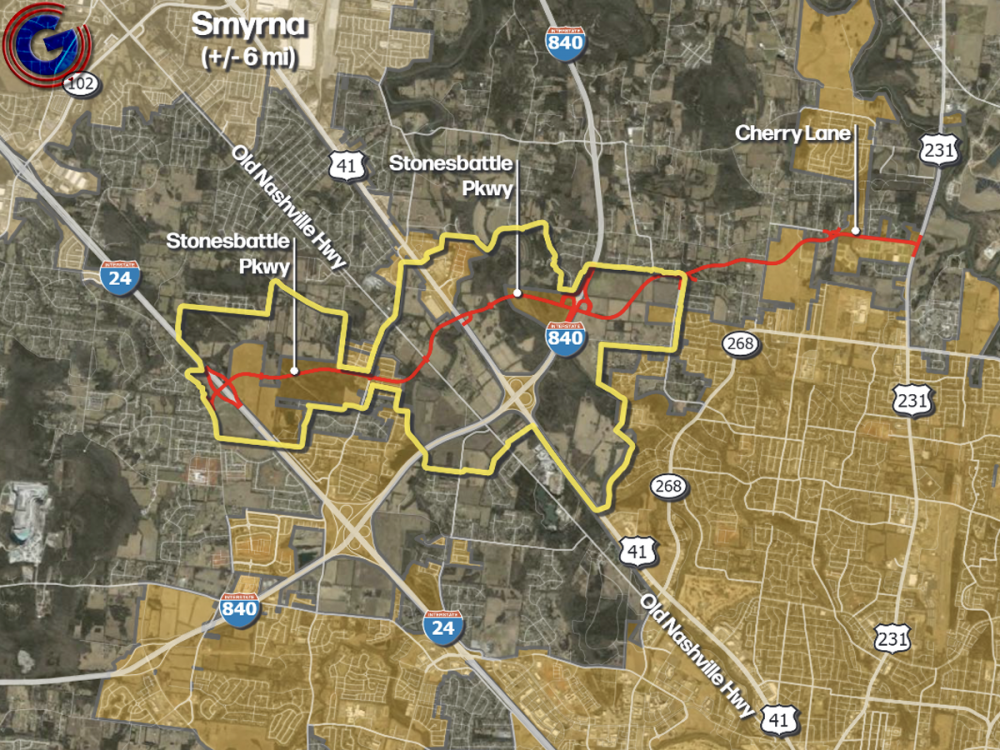
MURFREESBORO, Tenn. (WGNS News Summary) - Murfreesboro leaders approved a new long-term road and development plan called the Stonesbattle Parkway Corridor Plan to help manage the city’s fast growth. The project is designed to reduce heavy traffic on busy roads like Memorial Boulevard, Old Fort Parkway, and Medical Center Parkway by creating a new east-west route across the city. The new roadway will connect areas from Lebanon Pike near Walter Hill to Veterans Parkway and eventually toward Interstate 24. City leaders say the project will also attract new businesses, jobs, and housing while encouraging walkable neighborhoods and smarter growth. The estimated cost of the project is around $150 million, and Murfreesboro plans to seek state and federal funding to help pay for construction. Officials believe the new parkway will improve traffic flow, support future growth, and create safer travel options for drivers, cyclists, and pedestrians (Scroll down for the full details below).

Full Details on City Action of Road Expansion: Local leaders are taking decisive action to manage the rapid expansion of Rutherford County. On Thursday, May 21, 2026, the Murfreesboro City Council officially greenlit a Resolution of Support and Acknowledgement for the Stonesbattle Parkway Corridor Plan. This strategic blueprint outlines a comprehensive transportation and economic roadmap aimed at addressing the municipality's booming population, which has now surged past 175,000 residents.
Drafted by engineering firm Pape Dawson (formerly known as Ragan Smith), the initiative charts a clear path for future zoning, land management, and infrastructure progression along a vital new thoroughfare. The adoption follows a formal endorsement by the Planning Commission on May 6, 2026, after gathering public input, as well as a joint presentation earlier this year.
Mayor Shane McFarland emphasized the necessity of anticipating these infrastructure demands before they become overwhelming:
“This plan is about being proactive rather than reactive,”
Redefining East-West Transit - The primary goal of the multi-million-dollar project is to alleviate heavy vehicular volume on overburdened parallel streets. Drivers frequently encounter bumper-to-bumper delays on major paths such as Memorial Boulevard, Old Fort Parkway, and Medical Center Parkway. By engineering a continuous link from Lebanon Pike near Walter Hill through to Veterans Parkway in the Blackman neighborhood, transit planners intend to deliver an alternative corridor that successfully circumvents downtown bottlenecks.
This major arterial route, integrating the current Cherry Lane footprint, will feature varying designs to handle heavy daily travel. Certain stretches will consist of four-lane divided segments outfitted with landscaped medians, while other zones will utilize five-lane configurations featuring center turn lanes.
The comprehensive roadway moves forward across four distinct roll-out periods:

| Project Stage | Focus Area & Structural Milestones |
| Phase 1 | Comprehensive assessment of current traffic conditions along the existing Cherry Lane stretch. |
| Phase 2 | Extending the street network outward as a rural major artery, establishing the base alignment. |
| Phase 3 | Building foundational infrastructure, linking to Interstate 840, and refining the Northwest Broad Street crossroads. |
| Phase 4 | Achieving ultimate buildout by transitioning into an urban thoroughfare, including looking into an Interstate 24 interchange. |
Fostering Smart Growth and Economic Opportunity - The new roadway transitions in name, known as Cherry Lane east of I-840 and shifting to Stonesbattle Parkway on the western side of the highway. It will span from US 231 (Lebanon Pike) westward across the interstate toward US 41 (Northwest Broad Street), Florence Road, and eventually down to I-24. While state officials assess whether a full highway interchange or an elevated flyover bridge will connect the road to I-24, city leadership remains confident in the corridor's transforming potential.
City Manager Darren Gore highlighted the long-term logistical benefits of the framework:
“The corridor is one of the most significant future transportation investments in Murfreesboro. By linking multiple major arterials, the roadway is expected to provide much‑needed east‑west capacity relief, reduce congestion on parallel routes, and open new opportunities for coordinated development. We anticipate that the new roadway’s connectivity will make the area one of the most attractive locations for new commercial, mixed-use, and employment-based development.”
To properly accommodate the expected commercial and residential interest, the Planning Commission recently updated local zoning guidelines. These updated regional maps replace previous property designations to foster walkable neighborhoods. This smart-growth philosophy seeks to minimize commute lengths, allowing Rutherford County citizens to live, work, and shop within tightly integrated local sectors. This strategy replaces sections of the older Murfreesboro 2035 Future Land Use Map to better reflect modern community needs.

Statewide Synergy and Funding Strategies - The multi-lane thoroughfare is also designed to harmonize with larger Middle Tennessee infrastructure shifts. Specifically, local planners are coordinating with the Tennessee Department of Transportation (TDOT) as the state advances its massive I-24 Southeast Choice Lanes project - a dynamic toll initiative aimed at easing the heavily congested stretch between Nashville and Rutherford County.
With an estimated total budget of $150 million, Murfreesboro is actively pursuing state and federal financial grants to fund future construction cycles. By integrating modern multi-modal alternatives like sidewalk networks and bike paths, the city aims to build long-term regional resilience, offering safer routes for both daily commuters and emergency services alike.